
Showing posts with label Good To Know. Show all posts
Showing posts with label Good To Know. Show all posts

Protein - Heather McClees
Here’s what to look for to tell if you’re lacking in protein:
Look for the following signs if you’re worried about protein deficiency:
- Anxiety/depression (amino acids fuel the neurotransmitters serotonin and dopamine that prevent depression and anxiety)
- Poor injury recovery (protein fuels muscle recovery and regrowth)
- Hair Loss/Breakage (protein supports collagen production in the hair, skin, and nails)
- Inability to focus (amino acids support brain performance)
- Constant muscle pain (protein helps muscle recovery and aids in repair)
- Brittle/Breaking Nails (protein supports collagen production in the hair, skin, and nails)
- Poor muscle tone, even with exercise (protein builds and maintains lean muscle mass)
- Constantly fatigued (protein is needed for a healthy metabolism)
- Digestive issues (protein aids in digestion)
It’s important to note that a diet too low in calories or too high in sugar will also cause these symptoms too, so eliminate those causes before you add more protein.
How Much Do You Need?
Most people only need 0.5 grams of protein per pound of body weight to maintain lean muscle mass, but could eat up to 1 gram of protein per pound of body weight to gain lean muscle.
Take a look at these awesome plant-based, protein-rich foods:
- Broccoli: 5 grams per cup
- Spinach: 5 grams per cup
- Rye Grains: 5 grams per 1/2 cup cooked
- Rolled Oats: 7 grams per 1/2 cup cooked
- Millet: 5 grams per 1/2 cup cooked
- Amaranth: 6 grams per 1/2 cup cooked
- Freekah: 5 grams per 1/2 cup cooked
- Teff: 7 grams per 1/2 cup cooked
- Buckwheat: 7 grams per 1/2 cup cooked
- Almond Butter: 7 Grams per 2 tablespoons
- Spirulina: 4 grams per teaspoon (!!)
- Chlorella: 2 grams per teaspoon
- Chia seeds: 10 grams per 2 tablespoons
- Flax Seeds: 5 grams per 2 tablespoons
- Cacao Powder: 5 grams per 2 tablespoons
- Maca: 3 grams per tablespoon
- Acai: 5 grams per 3 ounce frozen puree
- Kale: 5 grams per cup
- Lentils- 18 grams per cup
- Black Beans- 13 grams per cup
- Chickpeas- 13 grams per cup
- Tofu: 10 grams per 3 ounces
- Tempeh: 10 grams per 2 ounces
- Endamame (Soybeans) – 16 grams per cup
- Romaine Lettuce: 3 grams per cup
- Sunflower Seeds: 10 grams per 1/4 cup
- Almonds: 7 grams per 1/4 cup
- Pumpkin Seeds: 10 grams per 1/4 cup
- Coconut Flour: 3.5 grams per 2 tablespoons
- Quinoa: 7 grams per 1/2 cup cooked
- Plant-Based Protein Powders (hemp, pea, brown rice, cranberry bean, soy, etc.) : 17-25 grams per scoop (depending on the brand)
- Green Peas: 8 grams per cup


Natural Appetite Suppressant Foods
Depending on the time of the day and how hungry one is, the right quantity of these foods will have to be consumed. For example, it is not recommended, that one has fruits after dusk. Here is a list foods which will help in alleviating hunger.
Apples
Apples are the best appetite suppressants. The fiber content in the apples gives a feeling of fullness. The other benefit of eating an apple is that it takes longer to digest. It is advised to chew the apples well, as the brain takes 20 minutes to understand that the stomach is full. Chewing well will ensure that one gets the feeling of fullness, while one is still eating the apple.
Citrus Fruits
Fruits like oranges, tangerines, sweet limes, etc. can be had, whenever one is hungry. The best about these fruits is that they are a good source of fiber, due to which a person does not feel hungry soon enough. Since they are watery in nature, they do not cause weight gain, and are therefore recommended for people on a weight loss diet. However, one should not make juice out of these fruits, as it will not only lose all the nutrients, but it also will be stripped off, of its rich fiber content, which actually causes appetite suppression.
Green Tea
Green tea not only burns fat but also is a very good appetite suppressant food. It stimulates the release of hormones, which are responsible for curbing food cravings. One can have a couple of cups of green tea through the day, whenever one feels hunger pangs.
Almonds
Almonds contain pinolenic acid. Using this acid, the body is able to manufacture hormones, that suppress hunger. Therefore, almonds are recommended to be had either as a late afternoon snack or between breakfast and lunch. People on a weight loss diet are recommended that they have about 5 to 6 almonds. However, to derive the best benefits from them, it is important that one chews them well.
Oatmeal
Very often dietitians suggest an oatmeal breakfast, as it is one of the best appetite suppressing foods. The main constituents of oatmeal are carbohydrates, which take longer to burn, to be used for energy. Hence the person does not feel hungry often. At the same time oatmeal is also rich in fiber which is responsible for giving you a satiated feeling for a longer period.
Flaxseed
Flaxseed should be consumed raw to derive the best benefits of fiber content in it. If you do not like flaxseed taste, it can be added to your bowl of oatmeal or salad dressings as well. This will ensure that you have a double serving of the appetite suppressing foods.
Salads
It is advisable to consume a big bowl of salad before every meal. The fiber content in salad slows the process of glucose entering into the bloodstream, due to which the person will not feel hungry soon. One can bring variety to the high fiber diet by alternating between vegetables and greens. Try to include as many colors as you can in your salad bowl and try to alternate between different dressings, so that you are not bored of eating salads.
Soups
Soups are the best way to suppress hunger. However, it does not mean that you have creamy soups. Consume broths or clear vegetable soups to lose weight and be satiated for longer. Avoid using carbohydrate rich vegetables to make the soup, so that you do not up the carbohydrate quotient in your diet.
Salmon
If you love gorging on fish, then you will be happy to know, that salmon is an appetite suppressant, however, you will have to eat raw salmon as an appetizer. Raw salmon contains healthy fats and proteins, due to which after eating salmon the person does not feel hungry and ends up consuming far less number of calories.
Chocolate
The bittersweet taste of the pure dark chocolate will give you a very satisfied feeling. Although you should not forget that all chocolates are not appetite suppressants. Therefore, milk chocolates, etc., are not to be consumed for suppressing appetite.
Coffee
Coffee is one of the appetite suppressant foods. You can have a cup or two cups of coffee with non-fat cream. Try to avoid sugar in the coffee. However, make sure you also consume sufficient quantity of water along with coffee, so that you do not dehydrate yourself, as coffee dehydrates the system.
Whey Protein Powder
Whey protein helps in building muscle mass. The muscle mass burns the fats easily, which helps in weight loss. At the same time it also gives you a feeling of fullness. One can use whey protein to either make milkshakes or smoothies and add different fruits for added benefit.
Vegetable Juice
Juices made from wheat germ, vegetables, etc., have become very popular in recent times. These juices help in detoxifying the body as much as they suppress appetite. Remember these drinks should be low in calories and should not contain sugar. The juices keep hunger at bay. However, I would recommend that you have the juice along with fiber in it.
Watermelon
Watermelon is known to be a rich source of fiber. The water content in watermelon ensures one feels satiated soon after eating a few pieces of watermelon. If you are going out for a meal, then you can have a small bowl of watermelon before venturing out, so that you do not end up over-stuffing yourself.
Pine Nuts
Pine nuts are said to have maximum amount of proteins. It is a regular practice in Serbia to consume a handful of pine nuts at meal time. The pine nuts are said to stimulate two hunger suppressing hormones. Therefore, whenever you feel hungry, you know you should be reaching for pine nuts, as opposed to chips and fizzy drinks.
Berries
Berries include cherries, strawberries, mulberries, blueberries, salmonberries, raspberries, lychee, etc. They are rich in fiber and are known for their antioxidant properties. Eating a handful of berries will satiate your hunger and you will not feel hungry for a longer period.
Natural Pickles
If a survey had to be carried among food items to find, which food item has the highest satiety rate, then pickles will certainly top this list. According to studies carried out, natural pickles have a higher rate of pound-for-pound satiety rate. Therefore, if 1 pound of pickles and same quantity of French fries is consumed, a person will be far more satisfied with pickles as opposed to French fries. The only trick that one needs to remember is that one should stick to natural pickles, so that they are not loaded with preservatives and sugars.
Water
Water helps in keeping the body hydrated and keeps hunger at bay. If you have a glass of water before your meals it will help in suppressing your hunger. Since the brain takes about twenty minutes to register, that the stomach is full, it is recommended that water be had at least 20 minutes before meals.
If you are on a weight loss diet, then it is best to consult your dietitian for the right quantity of these foods, which will ensure you are able to derive the best benefits from them. The best part of all the appetite suppressant foods is that they do not have side-effects. These foods will help you lose weight over a period of time, minus the cravings and starving!

Solar Power


Solar Power Design
Step 1 – How much power do you use?
Step 2 - The Battery Bank
Step 3 - What Solar Panels do you need?
Step 4 - The Solar Charge Controller
Step 5 - Mounting the Solar Panels
Step 6 - Connecting the Solar Power System
Step 7 - The Battery Bank is flat.
STEP 1 - HOW MUCH POWER DO YOU USE
To work out your power requirements, you need to look at all the devices to be connected to your solar power system. Each device will have a wattage rating which can be obtained usually by googling the model and the words watt power.

If you cannot find the watt rating of the device using google, you can use a multimeter or a very good device to have on hand is a product called a kill-a-watt. A Kill-a-watt is a device with a similar shape to a surge protector with a small screen. It tells you how many watts per hour the device that you plug into it will be using.
Important Note:
You should always look for 12 volt equipment. If your device can not handle a 12 volt supply you will need to get a 12volt DC to X volt DC Converter which means loosing some power during the conversion. The above mentioned reference devices can handle a direct connection to a 12 volt battery which makes them suitable for solar use.
Another important note is that you should only use DC devices. If the device's transformer says it has an AC output, then it will have extra supply requirements that cost more and has a power loss through the DC to AC conversion.
Once you have worked out the watt ratings of all your devices, add them together.
If we had 5 units of 12V DC CFL - 7W Solar Lamps, we would be using a total of 35 watts per hour.To work out how many watts per day, multiply the hourly usage by 24.
For our 5 Solar Lamps the wattage per day is 840 watts.
STEP 2 - THE BATTERY BANK
A Battery bank is used to store captured solar power for using at night or on rainy / overcast days. Your battery bank needs to be made of one or more deep cycle battery that will run your equipment for a number of days without sunlight. A good goal in most areas would be to run for 4 or 5 days without sunlight.
What is a deep cycle battery?
A Deep Cycle Battery is a special type of large capacity battery which can be discharged regularly to about 50% of its capacity. They are a similar size to a car battery but the difference is the chemicals inside.
A car battery is designed to be discharged only a small amount, then recharged instantly. Discharging a car battery will leave it with a very bad memory effect and this effect worsens as it goes without being recharged. 20 large discharges may damage a car battery and stop it from ever being fully charged again, where as a deep cycle battery can handle several hundred deep discharges, and go longer without being recharged.
Even with the discharge capability of a deep cycle battery, it should never drop below 50% of its capacity, but can go several days or sometimes weeks without being recharged and still be as good as new.
A Deep cycle battery will have a rating on the side. It will specify a voltage - usually 6 or 12, and an Amp-Hour / Ah rating. More expensive batteries will have a higher Amp-hour rating and therefore have a larger capacity. It is recommended that you purchase 12 volt batteries because your solar panels will most likely be 12 volt. If you need to purchase 6 volt batteries, they can be wired in a special way to increase the voltage to 12. You can purchase more batteries to add capacity as we will see below.
Wiring Methods
There are 2 ways to wire batteries together. You can use both at the same time if you like.
Parallel: This means that the Amp-Hour capacity of the batteries will be added together
Series: This means that the voltage of the batteries will be added together.

So what size battery bank do you need?
You will need a battery bank that will power your devices for a set amount of days without sunlight, and still not be discharged more than 50%. A good goal in most areas would be to run for 4 or 5 days without sunlight.
To work this out, we take the daily power usage, multiply it by the number of days without sunlight, and then multiply again by 2 so we factor in the 50% discharge limit.
In our 5 Solar Lamp sample;
5 Solar Laps is 840 watts per day.
Days Usage without sunlight is 4 days.
Thus 840 watts/day x 4 days x 2 equals 6,720 watts.
This means our battery bank capacity needs to be 6,720 watts.
To convert the watts back to amp-hours, we would divide by the battery voltage rating of 12 volts.
6,720 watts / 12 volts = 560 amp-hours
To achieve this, we could have:
5 units of 12 volt 120ah batteries wired in parallel.
For a 12vdc 600 amp-hour battery bank.
We could use 5 units of TROJAN T1275-AGM 12V DC Deep Cycle Battery.

Types of Batteries
Flooded / Wet Cells: The older and more common type of deep cycle battery. Needs maintenance such as water top ups. Water is lost in gases when charging.
Gel or AGM: Are sealed and maintenance free. There is no gas lost because the battery case is sealed and a special solar controller needs to be used so that the built up pressure from the gasses does not damage the battery. Gel or AGM are able to deliver more power, faster and so are ideal for starting engines or using on boats.
STEP 3 - WHAT SOLAR PANELS DO YOU NEED
This depends upon the average daily sunlight hours in your area during rainy season.
Insolaton is the correct measurement to use. Insolation is a measurement of the sun's energy that reaches a specific area of the earth's surface. It is more accurate than sunlight hours as it takes into account the angle of the sun, and various other environmental factors.
Sunlight hours can easily be used where you are using less than 20 watts of load***
In the example scenario, we have 4 hours each day on average during the rainy months.
Sunlight hours in Manila, Luzon range between 4:17 each day in September and 8:36 for every day in April
The solar panel will need to be able to capture enough solar power to run your equipment for the day, as well as recharge your battery bank following a rainy or overcast period. It also needs to be able to do this during wet season.
Hours of sunlight is 4 hrs.
24 hrs of power for 5 Solar lamps is 840 watts
840 watts / 4 hours = 210 watts
We need 210 watts of solar panels.
A different calculation when we factor in the recharging after a rainy or overcast period. If it rained for 4 days, and on the 5th day it was sunny, that is 5 days worth of power that needs to be captured. In the example that is 4,200 watts worth of power. We also need to capture this power as fast as possible before it rains again. So to capture 4,200 watts of power during 4 hours of sunlight, that means we need a 1.050 watt panel.
(5 days x 840 watts per day) / 4 hours = 1,050 watt Solar Panel for 1 day of charging
If we wanted to, we could set a goal of recharging the batteries over 2 days. That means we have 8 hours to capture 6 days worth of power - which a 630 watt panel would be able to do.
(6 days x 840 watts per day) / 8 hours = 630 watt Solar Panel for 2 days of charging
If you decide to set a longer recharge period, you can save some money on solar panels, but will need to spend more on adding more capacity to your battery bank in case you only get one sunny day and it returns to rain.
It is also probable that if you have an average of 4 hours of sunlight per day in rainy season, that also means half the days will be rainy or overcast, and the other half would be sunny. This means that on the sunny day, there could be up to 8 hours to capture the required power instead of the 4 assumed above. It is best to oversize your panels just in case, so you should not rely too much on extra average sunlight hours from rainy days.
Few solar panels over 140 watts are available in 12 volt versions. So to achieve a 1,050 watt Solar Panel, we have to connect in parallel multiple panels.
We can use the Kyocera KD140SX-UFBS which is a 140 watt 12V DC Solar Panel.
For 1,050 watt Solar Panel; 8 units of 140 watt solar module
For 630 watt Solar Panel; 5 units of 140 watt solar module

Types of Solar Panels
Polycrystalline: Are cheaper to produce, but are not as efficient as mono. Panels are usually larger for the same watt rating.
Monocrystalline: Are more expensive to produce but are more efficient than poly and can capture the more watts per square foot of solar cells.
Overcast Days: Some panels will still capture solar energy when there is a light overcast of cloud (bright white clouds) and they can sometimes work at up to 40% of the panel's rating. You may be interested in checking how your panel performs by using a multi-meter and testing the panel's output on an overcast day.
STEP 4 - THE SOLAR CHARGE CONTROLLERS
A solar controller can perform 6 main tasks
- Prevents power from the battery traveling back up and getting lost through the solar panel at night
- Prevents the panels from overcharging the battery by disconnecting them when the battery is full
- Gives an indication on the battery bank's State Of Charge
- Stops the batteries from being discharged too much by disconnecting your devices when the battery SOC gets too low.
- Counts how much power you have generated and how much power your devices have used
- Helps lower the amount of maintenance work required on your batteries by charging in certain ways
You will want to make sure you get a solar controller that will display the State of charge for your battery bank. This helps diagnose problems if your tower stops working and your customers need it fixed urgently.


STECA TAROM 4545
Sizing Solar Controllers
Your panels will have a maximum amp output current. If you have wired your panels in parallel, you will need to add together the maximum amp output current of each of them - you will want a controller that can handle at least this amount with plenty of capacity to spare. It may be wise to purchase a controller that handles double the current than what you need in case you wish to add more radios or panels in the future.
Also check if you have used gel or liquid flooded batteries and that the controller or regulator will work with your batteries. This is especially true if you use AGM or Gel batteries. The controller needs to be set to charge in a specific way so that it doesn't cause high gas pressure inside the sealed battery. Flooded batteries need ventilation because they are not completely sealed and gasses escape when charging.
The Load Output
One important feature of a solar controller is the load output. This is where you connect your devices. You must be careful with this feature though. Some controllers assume it will be to automatically control lighting and so switches the load output on in the evening and off during the day. Some controllers like the Steca brand pictured above-right, allow you to press a button to switch the load on or off, or use the menu to enable automatic functions such as turning it on x hours after darkness and off in the morning. The important thing is that it does allow the manual-only switching mode.
For our example;
We use 5 units of 140 watt solar panels with Ipm rating of 7.91A.
5 x 7.91A = 39.55AWe will use the Steca Tarom 4545; 12Vdc 45A as the controller which is sufficient for our example and with spare amperage.
STEP 5 - MOUNTING THE SOLAR PANELS
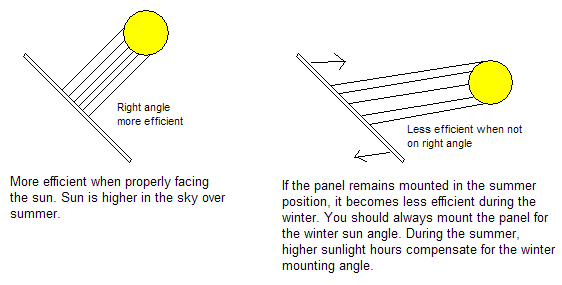
For peak performance solar panels need to be installed at roughly the same angle as the latitude of your site, thus allowing to maximize the amount of sunlight falling on the solar panel.
In this case, you will mount your panel so its surface is perpendicular to the sun's rays during winter.
Fixed Tilt
If your solar panels will have a fixed tilt angle then you want to get the most energy over the whole year. A fixed angle is convenient, but note that there are some disadvantages. A fixed angle will get less power than if you adjusted the angle. Also, if you live where there is snow, adjusting the panels to a steeper angle in winter makes it more likely that they will shed snow. A panel covered in snow produces little or no power.
Use one of these formulas to find the best angle from the horizontal at which the panel should be tilted:
If your latitude is below 25°, use the latitude times 0.87.
If your latitude is between 25° and 50°, use the latitude, times 0.76, plus 3.1 degrees.
If the latitude is above 50 degrees, then the full year angle will be 41.1, while the average insolation on the panel will be 5.1 times.
This table gives some examples for different latitudes. It also shows the average insolation on the panel over the year (in kWh/m2 per day), and the energy received compared to the best possible tracker.

The latitude of Manila is 14.5833° thus the optimum full year tilt angle
14.5833 x 0.87 = 12.7°More Solar Panel angle installation on http://www.solarpaneltilt.com/.
STEP 6 - CONNECTING THE SOLAR POWER SYSTEM
Size of wires for connections
We can refer to the specification requirement of the charge controller.
- From panel to controller, the specification is 4-AWG Stranded Wire or 2-AWG Single Wire.
- The same size of wire as above for battery bank to controller
- For the load, 14-AWG a normal lighting gauge specification in electrical codes.
STEP 7 - THE BATTERY BANK IS FLAT
So what do you do when you find its been raining for too long and your battery bank has gone flat. Ideally you should have
- A portable generator of around 300 watt with 12v DC and mains AC outputs - make sure the amp output of the 12v is less than your solar controllers limitation.
- A few backup batteries or pairs of batteries to swap into to your bank to run system for 2 days.
The first step would be to check the solar controller. Some with lcd screens will show an error code to help you diagnose the problem. If its just been raining too long then you will need to add another solar panel and expand the size of your battery bank to prevent it from happening again.
You can disconnect your solar panels, and connect the solar panel input of your solar controller to the 12v output of the generator and safely charge the battery bank and run your system again. For faster charging, you would disconnect the batteries from the solar controller and directly connect them to the 12v output of the generator.
Another way is to take out some fully charged batteries from your workshop and connect them in parallel to your battery bank - this will flow on to power your devices and slightly charge some of your batteries.


10 Foods That Actually Make You Eat More
BY Kurumi Fukushima
What if the type of food you're eating can alter brain function and promote overeating. That's right, certain foods can make you more hungry!
According to a 2013 study published in the American Journal of Clinical Nutrition by researchers at Harvard Medical School and Boston Children's Hospital, certain types of meals can increase hunger. More specifically, they found that a high glycemic index (or high-carb) meal stimulated the reward and craving regions of the brain, and affects eating behavior at your next meal.
And it's not just the foods high in carbohydrates. Thanks to a phenomenon known as sensory specific satiety, you can fill up on a whole bag of potato chips and feel like only your salty stomach is full. That leaves you wanting to fill up your sugary stomach, your sour stomach, your spicy stomach... well, you get the picture.
So, we've come up with a list of 10 foods that make you hungrier and eat more!
10. Alcohol
Who doesn't love a nice glass of vino at the end of a long day. Be careful.
Whether it's after a tough day at work, or a long night of partying, drinking alcohol is known to give you the 'munchies.' According to research published in Alcohol & Alcoholism, just three servings can lower levels of leptin, a hormone designed to keep hunger at bay, by 30%.
Scientists have found that alcohol directly interferes with the appetite controls of the brain called the hypothalamus, triggering this part of the brain to make us crave high calorie food.
9. White Pasta
If you look at the serving size of pasta, chances are you'd be shocked. One serving is one-half cup of cooked pasta.
It's hard to get full from eating one-half cup of pasta, right? Restaurants regularly serve up about four cups in a single entrée -- thats's eight servings you're eating!
When you overload your body with simple carbs, your pancreas goes into overdrive churning out insulin. Too much insulin as you know, drops your blood sugar levels, making you super hungry.
8. MSG
Monosodium glutamate or MSG is in many processed foods. It's a flavor-enhancer.
You've probably heard of it if you eat Chinese food or canned soups and veggies. One animal study from Spanish researchers concluded that the chemical triggers a 40% increase in appetite and could be one of the key factors behind the problem of obesity, El Pais reported.
To make things worse, the effects can compound over time, so the more frequently you eat MSG, the more you'll eat!
7. Pastries
The white flour used to bake most of these delicious treats have been stripped of the bran, its outer shell, leaving you without the grain's feel-full fiber content. Eating it spikes your insulin levels as well. Add to that the sugary jelly, custard cream, and chocolate to make whatever pastry and you get a food that does not fill your stomach for too long.
6. French fries
A potato is a starch made up of simple carbohydrates, which means our body absorbs and metabolizes it very quickly because of their small molecular size. Therefore, it will most cause an insulin surge.
The insulin surge causes too much blood sugar to be transported out of our blood and this results in our blood sugar levels to fall. Since our blood sugar level can affect how hungry and how energetic we feel, a drop below normal levels leave us feeling tired and hungry and wanting to eat more.
It also makes us want to eat something else with a high sugar content -- which of course, starts the cycle all over again.
Add to that, the hydrogenated vegetable oil used to fry them plus the salt to top it off. Not healthy at all.
5. Pizza
Let's take a look at the making of a pizza pie. It's generally a combination of white flour dough, hydrogenated oils, processed cheeses, and preservatives that makes a delicious easy dinner for all. But, it's on this list for a reason. Those four ingredients can throw off your blood sugar levels, satiety hormone production, and hunger-regulating regions of your brain.
Stay away from those tempting dollar slices.
4. White bread
Similar to pastries, white bread is made of white flour, spiking your insulin levels. It is a high hypoglycemic index food, so it's digested quickly, leaving you hungry and maybe even eating more than you had planned to eat.
Opt for whole wheat bread which contains the bran to get that fiber, and keep you full for longer!
3. Juices
Let's think about how juices are made. The drink fools many people because it's made of fruits and vegetables which sounds healthy.
But in the juicing process you are removing all the fiber and are simply left with a sugary drink. Fiber is key to keeping you full. Just like choosing whole wheat bread instead of white bread, you might be better off by eating a whole fruit instead of drinking fruit juice.
2. Kids' cereals
Or any other cereals with high sugar content and a low amount of dietary fiber. These unhealthy cereals will lead to a spike initially, then a crash in sugar levels.
And we've already told you what happens when your blood sugar levels are lower than normal...
1. Artificial sweeteners
Put down that yellow, pink, or blue colored packet of artificial sweetener. Every time you drink a diet soda that's artificially sweetened, or you put an artificial sweetener in your coffee, your brain expects the energy boost you would get from ordinary sugars. But when it doesn't get it, the body tries to make up for the lack of energy it's expecting, and creates hunger!
The artificial sweeteners can satisfy your taste buds for a moment, but can't fool the brain into producing dopamine, which is linked to a feeling of reward. Therefore, these sugar substitutes are not really substitutes, as artificial sweeteners make you more likely to binge on sugar later.
Breathing Techniques
Proper breathing is the very essence of life. It is how our vibration works and why it happens. Breathing is the most important life function we perform. It regulates the heartbeat. Proper deep breathing is a natural way to increase the energy level and the enjoyment of life. It is the method we use to take in oxygen, which enables us to perform the activities of life and as a way of eliminating 70 percent of all the wastes generated by the body.
The practice of deep breathing exercises accelerates the intake of oxygen. Oxygen is the most important chemical in the body. It is a powerful stimulant. The body requires about 88 pounds of oxygen daily. Its main function is purification. Hemoglobin, the red element in the blood, is an iron molecule that is magnetic. It reacts to vibration to produce the oxygen carrying component of the blood. Iron is a positive ion and oxygen is a negative ion. Negative ions are attracted to hemoglobin. These are the most abundant substances in the body. Deep breathing recharges the hemoglobin.
We take approximately 21,600 breaths of air each day. The slower and deeper the breathing, the longer the life span. Rhythmic deep breathing is Nature's tranquilizer and can be used to reduce stress and release pain.
Learn to breathe energy as well as air. The result will be increased electromagnetic flow into your body, which will bring up suppressed feelings. When you learn to open your breath and relax in the presence of your feelings, you align yourself with your natural healing flow of aliveness. Your awareness will be heightened, old behavior patterns will disappear and physical dis-ease will be replaced with health and youth. The reults are permanent.
Conscious connected breathing is communication with the source of life and a deep peace within ourselves. With proper breathing the physical body feels lighter, freer and we are clearer in our thinking. We will experience a more joyous outlook, emotionally we will be calmer and more serene in dealing with the situations that arise in our daily lives. During tense or anxious times, pause for a moment and become aware of your breathing. Breath slowly and deeply. With each breath comes an increase in peace. The key is to become mindful of the breathing process. The easiest way to focus in the present is to spend time consciously breathing deep into your lungs. Continue this practice until you do not have to think about the process, then it will become automatic. Conscious connected breathing allows us to live in the now.
Breath of Fire
This exercise is done while sitting in a chair or on the floor. Take a deep breath in through the nose, then exhale quickly and forcefully, out through the mouth. Inhalation through the nose will happen naturally after each exhalation. Placement of hands is optional. It must be performed for one full minute followed by one minute of rest and then another minute of breathing exercise for a total of five minutes. This technique helps in the metabolism of fat. Avoid cold drinks afterwards. This activity is equivalent to running two miles.
***


Eleven Signs Of SomeOne Lying
By Dr. Lillian Glass
1. They change their head position quickly.
If you see someone suddenly make a head movement when you ask them a direct question, they may be lying to you about something.
"The head will be retracted or jerked back, bowed down, or cocked or tilted to the side," writes Glass. This will often happen right before the person is expected to respond to a question.
2. Their breathing changes.
When someone is lying to you, they may begin to breathe heavily, Glass says. "It's a reflex action."
When their breathing changes, their shoulders will rise and their voice may get shallow, she adds. “In essence, they are out of breath because their heart rate and blood flow change. You body experiences these types of changes when you’re nervous and feeling tense — when you lie.”
3. They stand very still.
It's common knowledge that people fidget when they get nervous, but Glass says that you should also watch out for people who are not moving at all.
"This may be a sign of the primitive neurological 'fight,' rather than the 'flight,' response, as the body positions and readies itself for possible confrontation," says Glass. "When you speak and engage in normal conversation, it is natural to move your body around in subtle, relaxed, and, for the most part, unconscious movements. So if you observe a rigid, catatonic stance devoid of movement, it is often a huge warning sign that something is off."
4. They repeat words or phrases.
This happens because they're trying to convince you, and themselves, of something, she says. “They’re trying to validate the lie in their mind.” For example, he or she may say: "I didn't...I didn't..." over and over again, Glass says.
The repetition is also a way to buy themselves time as they attempt to gather their thoughts, she adds.
5. They provide too much information.
"When someone goes on and on and gives you too much information — information that is not requested and especially an excess of details — there is a very high probability that he or she is not telling you the truth," writes Glass. "Liars often talk a lot because they are hoping that, with all their talking and seeming openness, others will believe them."
6. They touch or cover their mouth.
"A telltale sign of lying is that a person will automatically put their hands over their mouth when they don't want to deal with an issue or answer a question," says Glass.
"When adults put their hands over their lips, it means they aren't revealing everything, and they just don't want to tell the truth," she says. "They are literally closing off communication."
7. They instinctively cover vulnerable body parts.
This may include areas such as the throat, chest, head, or abdomen.
"I have often seen this in the courtroom when I work as a consultant for attorneys. I can always tell when someone's testimony has hit a nerve with the defendant, when I see his or her hand covering the front of his/her throat," says Glass.
"I never appreciated the potential use of this very telling behavior until I joined the FBI as a Special Agent," she says.
8. They shuffle their feet.
"This is the body taking over," Glass explains. Shuffling feet tells you that the potential liar is uncomfortable and nervous. It also shows you that he or she wants to leave the situation; they want to walk away, she says.
"This is one of the key ways to detect a liar. Just look at their feet and you can tell a lot."
9. It becomes difficult for them to speak.
"If you ever watch the videotaped interrogation of a suspect who is guilty, you will often observe that it becomes more and more difficult for her to speak," writes Glass. "This occurs because the automatic nervous system decreases salivary flow during times of stress, which of course dries out the mucous membranes of the mouth."
Other signs to watch out for include sudden lip biting or pursed lips.
10. They stare at you without blinking much.
When people lie, it's common that they break eye contact, but the liar could go the extra mile to maintain eye contact in attempt to control and manipulate you.
"[Bernie] Madoff, like most con men, overcompensated and stared at people longer than usual, often without blinking at regular intervals," says Glass. "When people tell the truth, most will occasionally shift their eyes around and may even look away from time to time. Liars, on the other hand, will use a cold, steady gaze to intimidate and control."
Also watch out for rapid blinking.
11. They tend to point a lot.
"When a liar becomes hostile or defensive, he is attempting to turn the tables on you," says Glass. The liar will get hostile because he is angry that you've discovered his lies, which may result in a lot of pointing.
***

Yogurt Recipe
Homemade Yogurt
This is a simple recipe: a few tablespoons of pre-made yogurt gives the necessary base while the milk makes up the bulk of the yogurt. I have listed whole milk as the starting point but you may use non-fat, low-fat, (unsweetened) soy milk, etc., and the formula remains the same.
Makes 1 quart of yogurt
1 quart whole milk
1/4 cup plain whole milk yogurt
Have a 1 quart jar with a screw-on lid (or several smaller jars) ready and boil water. Pour the boiling water into the jar and let it stand for 5 minutes to sterilize it. Pour out the water and set aside.
In a large, heavy-bottomed saucepan heat the milk until it reaches 180 degrees on a thermometer. Remove from heat, keeping the thermometer in the pot.
When the temperature drops to 115 degrees, stir in the yogurt until thoroughly incorporated. Pour the mixture into the jar and screw on the lid.
Place the yogurt in a warm place and leave it undisturbed for 10 to 12 hours. You can wrap the jar with a towel if your house is a bit cool. For a thicker, tangier yogurt, let yogurt sit an additional 3 to 5 hours.
Refrigerate yogurt for at least 3 hours before eating.
Greek-Style Yogurt
You can make your homemade yogurt slightly thicker and more like Greek yogurt.
Makes 2 cups
Line a medium-large bowl with a piece of cheesecloth and dump 2 cups of homemade yogurt into the center of the cloth.
Bring the four corners of the cloth together and lift the yogurt over the bowl and twist the corners to squeeze out the liquid (it will drain through the cloth).
Continue squeezing to force the liquid out. When the majority of the surface liquid has been drained, it will start to drip more slowly. Tie off the top of the cloth just above the mass of yogurt with string.
Place the cloth containing the yogurt in a strainer or colander and place the strainer or colander in a bowl where it doesn't touch the bottom; liquid will continue to drain.
Place the bowl containing the strainer/colander in the refrigerator and let drain for 2 to 3 hours. After draining, take the cloth containing the yogurt and put it in the sink (do not remove the string). Using your hands, squeeze out any remaining liquid.
Remove the string, open the cloth and using a spatula, scrape out the yogurt into a bowl. Yogurt should be at least as thick as sour cream.
10 Ways To Fall Out Of Love With Someone
By BRIANNA WIEST
1. Write down why it didn’t work and the ways you weren’t happy and keep that list with you. Read it when you inevitably start thinking of all the reasons why you miss them, and why they were so perfect for you. We all romanticize the love we once had, but if and when we get it back, we realize that it’s just the same as it was. When it comes to the past, nothing changes but how we view it. Be conscious of that.
2. Learn to differentiate between love, lust and attachment. Now, I’ll argue that love actually is a deep form of attachment, but in many ways, these three can be different, unique experiences that don’t add up to enough cause for spending the rest of your life with someone. It’s okay to be in lust. It’s okay to be attached. You don’t have to be forever though.
3. Realize that relationships aren’t supposed to make you feel good as much as they are supposed to teach you something, and to help you grow. Allow someone to be part of your story and not the tragic, final scene. Take from it what you need to learn. If it showed you all the unloving parts of yourself, work on those, that’s what it was supposed to do. We have a tendency to exacerbate relationships by the way in which we categorize them as good bad or ugly, and yet, for some reason, no matter which way we go, we always want to hold on for just a little bit longer.
4. Cut off all contact. You can’t pick and choose right now, and it’s great if you can get into a friendship one day, but until your feelings have faded, you need to take some distance. This is absolutely essential. Stop checking their social media, don’t ask friends about how they’re doing. You don’t have to be a jerk about it, and you can politely let them know that it’s best for you to take some time away from them (although it usually doesn’t go that smoothly) it’s important that it’s said and followed through with regardless.
5. Let yourself be sad. Resisting it makes it worse than it is. Give yourself time to mourn and grieve the loss of someone who was a big part of your life. Then let them go, and love yourself enough to let yourself go too. As in, let yourself walk away from them in the metaphorical sense. Nobody else will give you permission.
6. Don’t get frustrated when your thoughts inevitably keep drifting back to that person. Just let them recess and pass. This is really how you should deal with all of your negative thoughts, but doing so becomes increasingly difficult when the subject matter is something you want to cling onto like an addict. You have to embrace the fact that letting those thoughts wash over you and fade is the best thing you can do for yourself and for your post-relationship relationship.
7. Don’t expect to get over them if you’re sitting in your bed all day thinking about them. Get out and do what you love, go visit friends you’ve lost touch with. Fall in love with other things and people and yourself. There are more loves in your life other than just romantic, and when you learn to enchant yourself with them, you find yourself needing a significant other less and less.
8. Embrace that you may never get over them, but let them be a part of your story anyway. Not every love has to result in a vow to spend forever together, and it doesn’t mean that what you had wasn’t real or worthwhile or beautiful. Part of the story can be that you simply always loved them, even long after you were over, and you know what? If you ask me, no matter how it turns out in the long-run, that is the most beautiful thing you can experience: loving someone despite everything. The only catch is, you have to be able to do it in an accepting way, or you’ll bury yourself in your heartache for the rest of your life.
9. Start to detach yourself. Something we all have to come to terms with is the fact that we attach ourselves to other people in light of what we think they can provide for us– whether it’s subconscious or not, we go into near panic mode when they leave us because we don’t know how we’ll get by. But we will, because we always do.
10. Learn to take your feelings and channel them into fuel to propel you toward something greater. If anything, motivate yourself to succeed in spite of them. It’s not the most positive way of going about things (and I do believe you should really do things for yourself) but for now, while you’re struggling, it’s not the worst way to cope. Let them do what they came into your life to do: make you better, however doing so played out
***
Stop worrying, if it is supposed to happen it will.
Allow yourself to be a beginner. No one starts off being excellent.
Don't let your happiness depend on anything outside of yourself.
Stay close to everything that makes you feel alive.
Listen to your body, it will lead you to unlimited health.
Surround yourself with people who see your greatness.
Make peace with your past.
See all setbacks as growth and expansive opportunities.
See all setbacks as growth and expansive opportunities.
Comparing yourself to others will hurt your health and steal your joy.
Don't give up, EVER.
You always have a choice.
Stop chasing what’s not working.
Believe wholeheartedly in miracles.
Don't postpone joy.
Trust the universe, there is a plan greater than yours.
Wake up every morning with a grateful heart.
Remember things take time.
Always trust your gut.
No need to change people; just love them for who they are.
Don't resist change.
Forgive yourself.
Your life is a creative adventure.
Release expectations and enjoy the journey, there is no destination.
Just do you.
You're not broken or damaged.
You are perfect just the way you are.
***
Spot True Smiles
Spot The Fake Smile
Results
You got 13 out of 20 correctLook at the labels below each image to see which smiles are genuine and which are fake.
Ticks and crosses show which smiles you got right and wrong.
Click on the image if you want to see the smile again.
 |
|
 |
|
| ||||
 |  |  | |  | |  | |  |
|
|
|
|
|
| ||||
 | |  | |  | |  | |  |
|
|
|
|
|
| ||||
 | |  | |  | |  | |  |
|
|
|
|
|
| ||||
 | |  | |  | |  | |  |
Most people are surprisingly bad at spotting fake smiles. One possible explanation for this is that it may be easier for people to get along if they don't always know what others are really feeling.
Although fake smiles often look very similar to genuine smiles, they are actually slightly different, because they are brought about by different muscles, which are controlled by different parts of the brain.
Fake smiles can be performed at will, because the brain signals that create them come from the conscious part of the brain and prompt the zygomaticus major muscles in the cheeks to contract. These are the muscles that pull the corners of the mouth outwards.
Genuine smiles, on the other hand, are generated by the unconscious brain, so are automatic. When people feel pleasure, signals pass through the part of the brain that processes emotion. As well as making the mouth muscles move, the muscles that raise the cheeks – the orbicularis oculi and the pars orbitalis – also contract, making the eyes crease up, and the eyebrows dip slightly.
Lines around the eyes do sometimes appear in intense fake smiles, and the cheeks may bunch up, making it look as if the eyes are contracting and the smile is genuine. But there are a few key signs that distinguish these smiles from real ones. For example, when a smile is genuine, the eye cover fold - the fleshy part of the eye between the eyebrow and the eyelid - moves downwards and the end of the eyebrows dip slightly.
Scientists distinguish between genuine and fake smiles by using a coding system called the Facial Action Coding System (FACS), which was devised by Professor Paul Ekman of the University of California and Dr Wallace V. Friesen of the University of Kentucky.
Subscribe to:
Posts (Atom)