
Showing posts with label Good Living. Show all posts
Showing posts with label Good Living. Show all posts
Positively Begin Your New Day
By Krista Butler
1. Drink A Glass Of Water As Soon As You Wake Up
This re-hydrates your body, revs up your digestive system, and gets things flowing. You may notice positive changes like clearer skin and better digestion. Bonus points if you add a squeeze of fresh lemon juice or a teaspoon of apple cider vinegar.
2. Think Of One Thing For Which You Have Gratitude
This sets the stage for positivism throughout the day. If you come up with three or five things, even better.
3. Step Outside And Take A Deep Breath
Fill your lungs with fresh air. Even if it’s cold outside. This only takes 10 seconds! It reminds you that you are alive and breathing.
4. Move Your Body
You don’t necessarily have to do an intense workout before breakfast, but moving your body even a little is a great way to get the blood flowing and shake the body into wake-up mode. Simply doing a few stretches is a great option. Or turn on your favorite song and dance like no one is watching.
5. Say Your Affirmations
Look into the mirror and say something positive to yourself. Some ideas:

1. Drink A Glass Of Water As Soon As You Wake Up
This re-hydrates your body, revs up your digestive system, and gets things flowing. You may notice positive changes like clearer skin and better digestion. Bonus points if you add a squeeze of fresh lemon juice or a teaspoon of apple cider vinegar.
2. Think Of One Thing For Which You Have Gratitude
This sets the stage for positivism throughout the day. If you come up with three or five things, even better.
3. Step Outside And Take A Deep Breath
Fill your lungs with fresh air. Even if it’s cold outside. This only takes 10 seconds! It reminds you that you are alive and breathing.
4. Move Your Body
You don’t necessarily have to do an intense workout before breakfast, but moving your body even a little is a great way to get the blood flowing and shake the body into wake-up mode. Simply doing a few stretches is a great option. Or turn on your favorite song and dance like no one is watching.
5. Say Your Affirmations
Look into the mirror and say something positive to yourself. Some ideas:
- I radiate beauty, confidence and grace.
- Every cell in my body is healthy and vibrant.
- I feel great!


Solar Power


Solar Power Design
Step 1 – How much power do you use?
Step 2 - The Battery Bank
Step 3 - What Solar Panels do you need?
Step 4 - The Solar Charge Controller
Step 5 - Mounting the Solar Panels
Step 6 - Connecting the Solar Power System
Step 7 - The Battery Bank is flat.
STEP 1 - HOW MUCH POWER DO YOU USE
To work out your power requirements, you need to look at all the devices to be connected to your solar power system. Each device will have a wattage rating which can be obtained usually by googling the model and the words watt power.
.bmp)
If you cannot find the watt rating of the device using google, you can use a multimeter or a very good device to have on hand is a product called a kill-a-watt. A Kill-a-watt is a device with a similar shape to a surge protector with a small screen. It tells you how many watts per hour the device that you plug into it will be using.
Important Note:
You should always look for 12 volt equipment. If your device can not handle a 12 volt supply you will need to get a 12volt DC to X volt DC Converter which means loosing some power during the conversion. The above mentioned reference devices can handle a direct connection to a 12 volt battery which makes them suitable for solar use.
Another important note is that you should only use DC devices. If the device's transformer says it has an AC output, then it will have extra supply requirements that cost more and has a power loss through the DC to AC conversion.
Once you have worked out the watt ratings of all your devices, add them together.
If we had 5 units of 12V DC CFL - 7W Solar Lamps, we would be using a total of 35 watts per hour.To work out how many watts per day, multiply the hourly usage by 24.
For our 5 Solar Lamps the wattage per day is 840 watts.
STEP 2 - THE BATTERY BANK
A Battery bank is used to store captured solar power for using at night or on rainy / overcast days. Your battery bank needs to be made of one or more deep cycle battery that will run your equipment for a number of days without sunlight. A good goal in most areas would be to run for 4 or 5 days without sunlight.
What is a deep cycle battery?
A Deep Cycle Battery is a special type of large capacity battery which can be discharged regularly to about 50% of its capacity. They are a similar size to a car battery but the difference is the chemicals inside.
A car battery is designed to be discharged only a small amount, then recharged instantly. Discharging a car battery will leave it with a very bad memory effect and this effect worsens as it goes without being recharged. 20 large discharges may damage a car battery and stop it from ever being fully charged again, where as a deep cycle battery can handle several hundred deep discharges, and go longer without being recharged.
Even with the discharge capability of a deep cycle battery, it should never drop below 50% of its capacity, but can go several days or sometimes weeks without being recharged and still be as good as new.
A Deep cycle battery will have a rating on the side. It will specify a voltage - usually 6 or 12, and an Amp-Hour / Ah rating. More expensive batteries will have a higher Amp-hour rating and therefore have a larger capacity. It is recommended that you purchase 12 volt batteries because your solar panels will most likely be 12 volt. If you need to purchase 6 volt batteries, they can be wired in a special way to increase the voltage to 12. You can purchase more batteries to add capacity as we will see below.
Wiring Methods
There are 2 ways to wire batteries together. You can use both at the same time if you like.
Parallel: This means that the Amp-Hour capacity of the batteries will be added together
Series: This means that the voltage of the batteries will be added together.

So what size battery bank do you need?
You will need a battery bank that will power your devices for a set amount of days without sunlight, and still not be discharged more than 50%. A good goal in most areas would be to run for 4 or 5 days without sunlight.
To work this out, we take the daily power usage, multiply it by the number of days without sunlight, and then multiply again by 2 so we factor in the 50% discharge limit.
In our 5 Solar Lamp sample;
5 Solar Laps is 840 watts per day.
Days Usage without sunlight is 4 days.
Thus 840 watts/day x 4 days x 2 equals 6,720 watts.
This means our battery bank capacity needs to be 6,720 watts.
To convert the watts back to amp-hours, we would divide by the battery voltage rating of 12 volts.
6,720 watts / 12 volts = 560 amp-hours
To achieve this, we could have:
5 units of 12 volt 120ah batteries wired in parallel.
For a 12vdc 600 amp-hour battery bank.
We could use 5 units of TROJAN T1275-AGM 12V DC Deep Cycle Battery.
.bmp)
Types of Batteries
Flooded / Wet Cells: The older and more common type of deep cycle battery. Needs maintenance such as water top ups. Water is lost in gases when charging.
Gel or AGM: Are sealed and maintenance free. There is no gas lost because the battery case is sealed and a special solar controller needs to be used so that the built up pressure from the gasses does not damage the battery. Gel or AGM are able to deliver more power, faster and so are ideal for starting engines or using on boats.
STEP 3 - WHAT SOLAR PANELS DO YOU NEED
This depends upon the average daily sunlight hours in your area during rainy season.
Insolaton is the correct measurement to use. Insolation is a measurement of the sun's energy that reaches a specific area of the earth's surface. It is more accurate than sunlight hours as it takes into account the angle of the sun, and various other environmental factors.
Sunlight hours can easily be used where you are using less than 20 watts of load***
In the example scenario, we have 4 hours each day on average during the rainy months.
Sunlight hours in Manila, Luzon range between 4:17 each day in September and 8:36 for every day in April
The solar panel will need to be able to capture enough solar power to run your equipment for the day, as well as recharge your battery bank following a rainy or overcast period. It also needs to be able to do this during wet season.
Hours of sunlight is 4 hrs.
24 hrs of power for 5 Solar lamps is 840 watts
840 watts / 4 hours = 210 watts
We need 210 watts of solar panels.
A different calculation when we factor in the recharging after a rainy or overcast period. If it rained for 4 days, and on the 5th day it was sunny, that is 5 days worth of power that needs to be captured. In the example that is 4,200 watts worth of power. We also need to capture this power as fast as possible before it rains again. So to capture 4,200 watts of power during 4 hours of sunlight, that means we need a 1.050 watt panel.
(5 days x 840 watts per day) / 4 hours = 1,050 watt Solar Panel for 1 day of charging
If we wanted to, we could set a goal of recharging the batteries over 2 days. That means we have 8 hours to capture 6 days worth of power - which a 630 watt panel would be able to do.
(6 days x 840 watts per day) / 8 hours = 630 watt Solar Panel for 2 days of charging
If you decide to set a longer recharge period, you can save some money on solar panels, but will need to spend more on adding more capacity to your battery bank in case you only get one sunny day and it returns to rain.
It is also probable that if you have an average of 4 hours of sunlight per day in rainy season, that also means half the days will be rainy or overcast, and the other half would be sunny. This means that on the sunny day, there could be up to 8 hours to capture the required power instead of the 4 assumed above. It is best to oversize your panels just in case, so you should not rely too much on extra average sunlight hours from rainy days.
Few solar panels over 140 watts are available in 12 volt versions. So to achieve a 1,050 watt Solar Panel, we have to connect in parallel multiple panels.
We can use the Kyocera KD140SX-UFBS which is a 140 watt 12V DC Solar Panel.
For 1,050 watt Solar Panel; 8 units of 140 watt solar module
For 630 watt Solar Panel; 5 units of 140 watt solar module
.bmp)
Types of Solar Panels
Polycrystalline: Are cheaper to produce, but are not as efficient as mono. Panels are usually larger for the same watt rating.
Monocrystalline: Are more expensive to produce but are more efficient than poly and can capture the more watts per square foot of solar cells.
Overcast Days: Some panels will still capture solar energy when there is a light overcast of cloud (bright white clouds) and they can sometimes work at up to 40% of the panel's rating. You may be interested in checking how your panel performs by using a multi-meter and testing the panel's output on an overcast day.
STEP 4 - THE SOLAR CHARGE CONTROLLERS
A solar controller can perform 6 main tasks
- Prevents power from the battery traveling back up and getting lost through the solar panel at night
- Prevents the panels from overcharging the battery by disconnecting them when the battery is full
- Gives an indication on the battery bank's State Of Charge
- Stops the batteries from being discharged too much by disconnecting your devices when the battery SOC gets too low.
- Counts how much power you have generated and how much power your devices have used
- Helps lower the amount of maintenance work required on your batteries by charging in certain ways
You will want to make sure you get a solar controller that will display the State of charge for your battery bank. This helps diagnose problems if your tower stops working and your customers need it fixed urgently.

.bmp)
STECA TAROM 4545
Sizing Solar Controllers
Your panels will have a maximum amp output current. If you have wired your panels in parallel, you will need to add together the maximum amp output current of each of them - you will want a controller that can handle at least this amount with plenty of capacity to spare. It may be wise to purchase a controller that handles double the current than what you need in case you wish to add more radios or panels in the future.
Also check if you have used gel or liquid flooded batteries and that the controller or regulator will work with your batteries. This is especially true if you use AGM or Gel batteries. The controller needs to be set to charge in a specific way so that it doesn't cause high gas pressure inside the sealed battery. Flooded batteries need ventilation because they are not completely sealed and gasses escape when charging.
The Load Output
One important feature of a solar controller is the load output. This is where you connect your devices. You must be careful with this feature though. Some controllers assume it will be to automatically control lighting and so switches the load output on in the evening and off during the day. Some controllers like the Steca brand pictured above-right, allow you to press a button to switch the load on or off, or use the menu to enable automatic functions such as turning it on x hours after darkness and off in the morning. The important thing is that it does allow the manual-only switching mode.
For our example;
We use 5 units of 140 watt solar panels with Ipm rating of 7.91A.
5 x 7.91A = 39.55AWe will use the Steca Tarom 4545; 12Vdc 45A as the controller which is sufficient for our example and with spare amperage.
STEP 5 - MOUNTING THE SOLAR PANELS
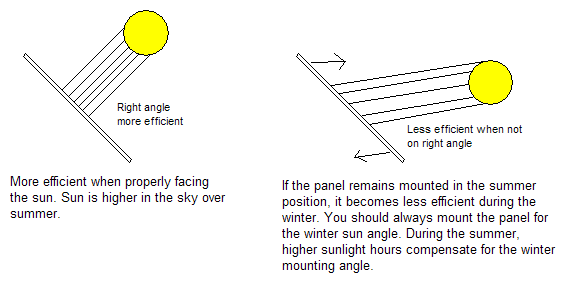
For peak performance solar panels need to be installed at roughly the same angle as the latitude of your site, thus allowing to maximize the amount of sunlight falling on the solar panel.
In this case, you will mount your panel so its surface is perpendicular to the sun's rays during winter.
Fixed Tilt
If your solar panels will have a fixed tilt angle then you want to get the most energy over the whole year. A fixed angle is convenient, but note that there are some disadvantages. A fixed angle will get less power than if you adjusted the angle. Also, if you live where there is snow, adjusting the panels to a steeper angle in winter makes it more likely that they will shed snow. A panel covered in snow produces little or no power.
Use one of these formulas to find the best angle from the horizontal at which the panel should be tilted:
If your latitude is below 25°, use the latitude times 0.87.
If your latitude is between 25° and 50°, use the latitude, times 0.76, plus 3.1 degrees.
If the latitude is above 50 degrees, then the full year angle will be 41.1, while the average insolation on the panel will be 5.1 times.
This table gives some examples for different latitudes. It also shows the average insolation on the panel over the year (in kWh/m2 per day), and the energy received compared to the best possible tracker.
.bmp)
The latitude of Manila is 14.5833° thus the optimum full year tilt angle
14.5833 x 0.87 = 12.7°More Solar Panel angle installation on http://www.solarpaneltilt.com/.
STEP 6 - CONNECTING THE SOLAR POWER SYSTEM
Size of wires for connections
We can refer to the specification requirement of the charge controller.
- From panel to controller, the specification is 4-AWG Stranded Wire or 2-AWG Single Wire.
- The same size of wire as above for battery bank to controller
- For the load, 14-AWG a normal lighting gauge specification in electrical codes.
STEP 7 - THE BATTERY BANK IS FLAT
So what do you do when you find its been raining for too long and your battery bank has gone flat. Ideally you should have
- A portable generator of around 300 watt with 12v DC and mains AC outputs - make sure the amp output of the 12v is less than your solar controllers limitation.
- A few backup batteries or pairs of batteries to swap into to your bank to run system for 2 days.
The first step would be to check the solar controller. Some with lcd screens will show an error code to help you diagnose the problem. If its just been raining too long then you will need to add another solar panel and expand the size of your battery bank to prevent it from happening again.
You can disconnect your solar panels, and connect the solar panel input of your solar controller to the 12v output of the generator and safely charge the battery bank and run your system again. For faster charging, you would disconnect the batteries from the solar controller and directly connect them to the 12v output of the generator.
Another way is to take out some fully charged batteries from your workshop and connect them in parallel to your battery bank - this will flow on to power your devices and slightly charge some of your batteries.
Happiness Mind Map
by Adam Sicinski

There are 33 keys of 5 fundamental aspects of life that deserve our wholehearted attention and care. Identify them, attend to them and fulfill their longings, and you will experience the joys and feelings of unbridled childlike happiness.


There are 33 keys of 5 fundamental aspects of life that deserve our wholehearted attention and care. Identify them, attend to them and fulfill their longings, and you will experience the joys and feelings of unbridled childlike happiness.
Cultivating a Happy Body
Our body is a vessel. It is the ship that sails us to our desired objectives and destinations. When the ship is properly maintained and cleaned, it sparkles with unbridled energy and radiance like a warm smile greeting us a good morning. In order to truly find long lasting and fulfilling happiness we must take care of our bodies. When our body feels good, it makes it easier to smile, to find happiness and joy in other areas of our lives. And this is exactly what this branch of the Study Matrix is about – cultivating a happy body.
- Smile Often – Turn your frown :( upside down :) A simple smile is such a wonderful thing that will immediately generate feelings of joy and happiness. Smiling often will stimulate wonderful feelings and sensations in your body helping you find more fulfillment throughout your day.
- Partake in Regular Exercise – Exercise encourages movement, deep breathing and releases built up stress. Partaking in regular, controlled exercise will generate wonderful invigorating feelings from deep within your body. This will lead to more happiness and joy in your life.
- Eat Healthy – Some foods can leave us sluggish and weak. Feeling rundown and low on energy will stir up unresourceful emotions which will lead to unpleasant and lackluster feelings. Focus on eating plenty of watery foods including fruits, vegetables, legumes, beans, etc. Also drink plenty of room temperature fluids throughout your day. This will stabilize your energy and keep happiness at the forefront of your mind.
- Sleep Restfully – The quality of our sleep patterns will effectively determine the quality of the emotions we experience throughout the day. Make sure to develop a good sleeping routine that provides you enough rest for your body, spirit and mind.
Cultivating Happy Actions
Our actions determine our results in life. When we take ill-fated actions, we experience the consequences of those decisions through stress, anxiety and despair. On the other hand, when we take actions that are sprinkled with happiness dust :), our outcomes are immediately transformed and we experience the consequences of a fulfilling and extraordinary existence. This branch of the Study Matrix breaks down some simple actions you can take on a daily basis that will bring a greater sense of joy and fulfillment to your daily undertakings.
- Experiment with Living – A mundane boring life can only lead to sluggish feelings that will weigh heavily on your body and mind. Choose instead to experiment a little, to partake in new activities and to fully enjoy great experiences that will leave your life with no regrets and plenty of unforgettable memories.
- Set Goals – When we have nothing to aim for, we struggle to find the motivation to get through our days. Decide today to set new goals and objectives that will move you into disciplined thought and action. The more inspiring the goals, the greater amount of joy, happiness and fulfillment you will find within your life.
- Prioritize – Our daily tasks and chores can easily overwhelm us if we are unable to manage them effectively. The solution rests in developing the habit of prioritizing all your tasks and activities into easily manageable and workable chunks. The more proficient you become at prioritizing your life, the more effective you will be, the more time you will have on hand, and the greater sense of happiness and fulfillment you will experience within your life.
- Seek New Learnings – When we fail to learn, grow and reach our full potential in any area of our life, we tend to experience an emptiness within the pit of our stomachs that breeds many unresourceful and dissatisfied emotions. If you suffer from this condition, simply take time to learn something new. Learn a new skill, develop a new talent, enhance your knowledge in a certain niche area of your life, or simply ask someone to teach you something that you have very little knowledge about. When you learn you will grow, and as you grow you will experience the joys of living to your fullest potential. The outcome always results in a sense of fulfillment and satisfaction in life.
- Simplify Your Life – We struggle to get by in life because we simply take on board too many responsibilities, collect too much clutter and involve ourselves in mundane tasks and activities that deflate the spirit and weaken the mind. Tomorrow, step into your life as a new person, and begin to simplify every aspect of your reality. Get rid of the junk, cut down on the responsibilities and simplify everything that is useless and clutters your mind with too many thoughts and unnecessary emotions. Simplifying your life in this manner will be like stepping out of a prison after many years of mental and physical torture. This can only breed great joy, excitement and happiness into your life.
- Celebrate Your Achievements – Life is there to be enjoyed to its fullest. If you successfully reach your goals and objectives, than take a timeout to celebrate your accomplishments with your family, friends and loved ones. Celebrations will help inspire, motivate and move you towards even greater goals and objectives, bringing great joy and fulfillment into your life.
- Slow the Pace Down – Sometimes our busyness gets the better of us. We feel fulfilled and somewhat happy because we are moving at such a fast past, yet there is still that emptiness that lingers within the pit of our stomachs that is longing for something more. “More” comes when you stop and slowdown, change your pace and take time to smell the roses, tell someone you love them, and revel in the finer pleasures of life that bring you the greatest joy and happiness.
- Act through Your Passions – Your passions are the things that raise your energy, that bring you great satisfaction, and help you experience your world to its fullest. Regularly partake in your favorite hobbies, watch your kids play sports, and simply take charge of your life by creatively bringing your passions into your daily activities, thoughts and actions.
Cultivating a Happy Self
Our external happiness is primarily dependent on the internal happiness we feel within ourselves at any one moment in time. Our happiness always radiates out from within. Hence if we have little happiness to give, than we will likewise struggle to receive that which is given to us by others. This branch of the Study Matrix focuses on some simple strategies you can immediately bring forth into your life that will enhance and accentuate the happiness you feel within yourself.
- Pamper Yourself – It is so very easy for us to become stressed, anxious and overwhelmed as we go about our everyday ritualistic activities. During these periods we tend to forget about ourselves, our needs and our obligations to the ongoing wellbeing of our mind, spirit and body. The solution is to take time on weekly basis for some “Me Time”. Take a warm bath, get a relaxing massage, visit a spa, go to the gym, or simply take a walk in nature and spend some time with just your thoughts. These breaks will allow you to recharge your batteries and will help you to find the happiness and fulfillment you might be missing in your life.
- Find Humor and Laughter – Laughter will not only relieve your stress and the built-up tension within your body, it can also heal the soul and bring forth a vast amount of creative energy that will enhance and improve your day. Take timeouts throughout your days to laugh, to giggle like a school kid, to tell a funny joke to a friend, watch a sitcom on TV, or to simply make fun of yourself at the most awkward of moments. The more fun you have with this, the greater sense of joy and fulfillment you will experience in your life.
- Seek Inspiration – We struggle at times throughout the year because we lack the inspiration to move us forward. Inspiration is a state of mind that we must learn to cultivate as often as possible. It will help move us in thought and action, bringing a greater sense of joy and satisfaction into our lives. You can find inspiration in nature, by reading a book, by watching an inspirational movie, or simply through listening to your favorite piece of music. It does not matter how you go about finding your inspiration, as long as you work towards it each and everyday.
- Learn to Accept Your Circumstances – Our circumstances are what they are. Sometimes we have full control over them, while at other times we simply cannot influence them no matter what we do. As you go about your daily undertakings, it is important that you do not allow them to dictate the emotions that you experience within the moment. The one thing that you can control at all times is your pattern of thought. And it is your thought process (how you perceive a circumstance) that will determine how and what you feel at the end of the day. In fact there is no good or bad, it is rather how we perceive it to be. Start today by taking charge of your thought process, and bringing forth only happy feelings of joy and fulfillment into your life.
- Choose to be Happy – This is an easy one. Simply choose that you will be happy every moment of your day no matter what happens. Wake up in the morning and decide that you will be happy for the remainder of this day. If you are experiencing some difficult setbacks, than decide to be happy just for the next hour, and see what happens. Happiness is at all times your choice to make.
- Become Aware of Your Thoughts – True happiness begins in the mind. Pay attention to your everyday thoughts and the self-talk you allow to dominate your thinking habits. These thoughts will trigger instant feelings and emotions that will take over your entire body and mind. By becoming aware of these thoughts, you are essentially taking charge of the emotions you allow to dominate your decisions and actions at any moment in time. Choose your thoughts wisely and happiness will “think” its way through into your life.
Cultivating Happy Interactions
Sometimes happiness just seems too elusive and hard to achieve. It seems that no matter what we do, we just can’t seem to find that fulfillment and joy we have been searching for all our lives. In instances such as these, it is important to direct your energy outwards and touch the hearts of other people. We are naturally social beings, who seek support, encouragement and warmth from other like-minded individuals. The moment you begin directing your energy to make others happy, you will likewise tap into the reservoirs of the personal joy that rests deep within your heart. This branch of the Study Matrix focuses on finding joy and happiness through the process of building strong emotional relationships with others.
- Forgive Others – Holding onto ill-feelings towards others will only poison your mind and suffocate your soul. This will lead to many unresourceful emotions that will sabotage the happiness you desire to experience within your life. Take time today to forgive others for their indiscretions. If you find it difficult to forgive them openly, than write them a letter or simply close your eyes and genuinely tell them how you feel from the bottom of your heart. Only once this forgiveness has been released into the Universe, will you once again be free of the shackles that bind your emotions to the ground.
- Connect with Others – Loneliness can be an incredibly debilitating experience that can lead to many dirty and self-sabotaging unresourceful emotions of sadness, anger, sorrow and depression. Our emotions are like two sides of a mask. You cannot experience one type of emotion and its polar opposite at the same time. Decide today to switch that mask around and connect with other people through email, via telephone or in person. Tell them about your life, ask them questions about their experiences, goals and ambitions. It doesn’t matter how you connect, as long as you take the time to reach out to someone and ground yourself within their presence.
- Associate with Happy People – Happy people are those who will raise your energy through the roof the moment they walk into a room. Happy people are those who will inspire and motivate you when you are feeling down. Yes, happy people can indeed even cure your emotional self-sabotaging ways with a simple smile and giggle. Find these people within your community, school or group and work your way into their circle of friends.
- Volunteer Your Time and Energy – Believe it or not, there are actually people in this world who are much more disadvantaged than you. In fact, they are very unhappy and dissatisfied with their lives, and they are looking for inspiring individuals like yourself to bring some joy and fulfillment into their daily existence. Take time each week or month to volunteer your time to a charitable cause. Make an effort to bring joy and happiness into these people’s lives as best you can. You may actually be rather surprised how much warmth, satisfaction and fulfillment this can bring into your life. Sometimes through helping others find happiness, we end up finding it within ourselves.
- Partake in Random Acts of Kindness – Keep an ear out and pay attention to the events in other people’s lives. The moment you see an opportunity open up, decide to help them out in someway through a random act of kindness. Simply do something for them that they cannot do for themselves. The key here is to take no credit for your random acts of kindness. You will find greater fulfillment and satisfaction knowing that you helped someone because of the goodness of your heart – without obligating them to return the favor.
- Be Happy for Others – Sometimes we see wonderful things sprouting in other people’s lives and we somewhat feel happy for them, and yet at other times we feel small, inadequate and kind of jealous that we are not experiencing these same emotions. By consciously deciding to be happy for other people no matter what is currently transpiring within your experience, you will be sending positive vibrations into the Universe that will one day boomerang back into your life.
Cultivating a Happy Mindset
Our mind is a strange and mysterious thing. At one moment it can lead us into the pitfalls of despair, while during another moment, it can help us scale the heights of the highest emotional mountain peeks. It has been said that we become what we think about most of the time. Hence, if our mind struggles to deal with the problems that life brings our way on a daily basis, than it will experience the negative drawbacks, consequences and emotions of such thoughts manifesting within our physical reality. This branch of the Study Matrix focuses on the process of cultivating a mindset that will attract greater joy and happiness into your life.
- Have Faith in a Higher Power – Faith is a wonderful thing, as it helps us to persist through the most difficult of times and against the greatest of odds. Decide today to empower your faith by grounding yourself to God or the Universe through prayer, relaxation and meditation. Have faith that you will be happy no matter what obstacles stand in your way. And have faith that because of your happiness things will always turn out great at the end of your day.
- Detach Yourself from Circumstances – Circumstances are what they are. In fact circumstances are what we make them out to be at any moment in time. Decide to detach yourself mentally and emotionally from the circumstances in your life. Through detachment you will clarify your thinking and take control of what seemed so senselessly out of control moments ago. By breaking free of your emotional lock upon the circumstances of your life, you are opening up your spirit to the experience of greater happiness and fulfillment.
- Be Grateful for What You Have – Many of us long for objects, people and circumstances that are currently out of our reach. We long for these things because we don’t yet have them in our lives. This longing brings with it desperation, dissatisfaction and despair. Within this type of emotional “soil mixture”, happiness cannot grow. The solution rests in the spirit of gratitude. Start today by taking time to say “thanks” for the wonderful things in your life. Be grateful for your health, body, your friends, family, your current possessions, safety, life, etc. The more gratitude you find in your life, the happier you will become, and the more opportunities for further gratitude will arise as you go about your day.
- Expect to be Happy – Actually create a sense of expectation that you will always be happy with yourself, with your body, with your activities and with your life. You are in control of the expectations you send forth into the Universe. So take charge and expect to bring happiness into your life without any further hesitation or delay.
- Believe In Yourself – Believe in yourself, your abilities, your talents, your capacity to learn and manage your daily tasks, activities and responsibilities. It is only when you have a full sense of confidence within yourself about every aspect of your life, that you will find the joy and happiness you have been searching for all along.
- Alter Your Perspectives About Problems – Everything you see, hear, smell, touch and taste is just an opinion you made about the events and circumstances in your life. If things don’t appear to be going well… that is only your opinion. If you seem to have failed… that is only your opinion. If life seems to be going against you… that is only your opinion. Everything is an opinion and perspective that you have decided to accept. If your opinions are not bringing you the joy and happiness you seek to experience in your life, than simply decide today to change your perspective about these events and circumstances. If this is difficult to do, than ask someone else for their opinion, read a book that provides you with an alternative view of the situation, or simply decide that there are no problems in this world, only opportunities to grow and improve myself. Ask yourself, “What is the hidden opportunity here that I am not seeing?”
- Focus on Solutions – There are no problems in this world, there are only solutions that appear as problems in order to test our resolve and character. When you focus on problems you automatically begin to feel anxious, out of control, and overwhelmed with the uncertainties that lie ahead. On the other hand, when you focus on searching for solutions, you effectively raise your levels of energy, excitement, anticipation and happiness that a solution will surely be found. Therefore decide today to begin thinking in “solutions” rather than in “problems”.
Avoid Unhappiness
By following all the principles listed above, you will be well on your way towards experiencing true unbridled childlike happiness on a daily basis. However, sometimes it’s not so much what you do that matters. It’s rather what you refrain from partaking in that has the biggest impact on your thoughts and emotions at the end of the day. Some people will work extremely hard to do the right thing in order to experience the joy and fulfillment of unbridled childlike happiness. Yet, with an sudden ill-fated decision, without a moments notice they immediately sabotage their “emotional high” by doing something silly and self-destructive. This branch of the Study Matrix focuses on two key self-sabotaging decision oriented factors that will ruin your chances of experiencing true unbridled childlike happiness. It is important that you do not underestimate these two factors, as they can ruin a perfectly happy moment without warning or prior notice. Become aware of them, learn to understand them, and slowly take charge of the circumstances in your life that bring these two factors into being.
- Avoid Negative News – In this day of instant communication and information, it is easy to see how we can simply get caught up in a web of negativity that we cannot control. We watch people death on TV, we read about the wars raging around the world, and we feel sick, distressed and somewhat fatigued by these events. We must come to a realization that these events are very much out of our control. Getting ourselves emotionally distraught, does nobody any good. It’s important that we are not ignorant of the world around us, however it is also equally important that these events do not sabotage our resourceful emotional states. At all times we must stay in control of our emotions, while being positive, happy and moving forward. It is only through the act of making decisions and taking actions within this positive state that we can make a difference to this world.
- Avoid Pessimistic People – Imagine this scenario. You have had the most wonderful, inspiring and motivating day you have ever experienced in your life. You’re so excited about everything that you just can’t wait to tell you best friend all the wonderful details. That evening you catch up with them at the pub and begin telling all these wonderful tales… when all of a sudden BLAM!They wipe you out with their pessimistic negativity. They tell you how these feelings will never last, how the world will always be against you, how bad luck always hides around the corner, and so forth. 10 minutes ago you were feeling on top of the world, however all of a sudden your BEST FRIEND has completely transformed your perspective about the best day of your life and turned it on its head. What you thought was your most wonderful day ever, has now potentially become your worst nightmare, and it’s all because of the perspective that you have decided to accept within your reality. There goes your energy, spirit and motivation, and it only took 10 minutes. This is a very common scenario that has robbed many creative, motivated and inspired people of their dreams. If you have friends, colleagues or family members who bring you down in this way, maybe it’s time to spend a little less time with them and more time with those who could potentially inspire you to greatness.
How Oxytocin, the 'Love Hormone' Works Its Magic
By Brenda Goodman
A whiff of oxytocin lit up reward center in men's brains when they looked at their partner's face.
Scientists, and women everywhere, have long wondered exactly what keeps a man from straying with a stranger.
From a biological perspective, at least, cheating is easy to understand. The more sexual partners a man has, the more likely he'll be to pass on his genetic material.
So why do so many men settle down, get married and stick around to raise their kids?
Researchers think they may have found a clue in oxytocin, a hormone released during sex and other intimate gestures like hugging or holding hands that's been proven to strengthen social bonds in other mammals.
They found that the hormone appears to boost men's attraction to their mate -- even when presented with pictures of other women.
The findings are published in this week's issue of the Proceedings of the National Academy of Sciences.
In the study, 20 men who were in committed relationships for 28 months, on average, took whiffs of either oxytocin nasal spray or an inactive placebo spray.
For the first test, the men looked at pictures of their partner, a woman they'd never met, or a house. The photos of the women were carefully matched so one wasn't more attractive than the other.
In the second experiment, they looked at pictures of their partners or of women they knew but weren't related to, perhaps someone they saw at work every day.
Then the men rated the attraction they felt to the various faces. Men consistently rated their partners as being more attractive and arousing than the other women and, in most cases, a whiff of oxytocin boosted that effect compared to the placebo.
But what really fascinated the researchers was what happened inside the men's brains.
Under the influence of oxytocin, two areas of the brain responsible for feelings of reward and pleasure lit up when men saw their partner's faces. But the sight of other women had the opposite effect, suppressing feelings of pleasure.
"Oxytocin triggers the reward system to activate on the partner's face, the presence of the partner," said study author Dr. Rene Hurlemann, a professor of psychiatry at the University of Bonn, in Germany.
"Sexual monogamy is actually quite costly for males, so there must be some form of mechanism binding males and females together, at least for some time," Hurlemann said. "There must be some benefit, and reward is actually the strongest motivation underlying human behavior."
An expert who was not involved in the study said the results suggest that couples who keep a high level of intimacy in their relationships can maintain stronger bonds.
"When you're first becoming intimate, you're releasing lots of dopamine and oxytocin. That's creating that link between the neural systems that are processing your facial cues, your voice and the reward system" of a partner's brain, said Larry Young, a professor of psychiatry at Emory University in Atlanta. He studies the role of oxytocin in social bonding.
As time goes on, and couples become less intimate, Young noted that linkage can decay. But activities that release oxytocin, such as really looking into another person's eyes, holding hands, kissing and having sex may help restore the connection.
"To me, it suggests that it may be a way to help prevent the decay that can occur that leads couples to separate," he said.
Hurlemann agreed: "I think this is the only reason that we do hug and touch each other all the time. I think this is the mechanism that keeps oxytocin levels high in relationships."

A whiff of oxytocin lit up reward center in men's brains when they looked at their partner's face.
Scientists, and women everywhere, have long wondered exactly what keeps a man from straying with a stranger.
From a biological perspective, at least, cheating is easy to understand. The more sexual partners a man has, the more likely he'll be to pass on his genetic material.
So why do so many men settle down, get married and stick around to raise their kids?
Researchers think they may have found a clue in oxytocin, a hormone released during sex and other intimate gestures like hugging or holding hands that's been proven to strengthen social bonds in other mammals.
They found that the hormone appears to boost men's attraction to their mate -- even when presented with pictures of other women.
The findings are published in this week's issue of the Proceedings of the National Academy of Sciences.
In the study, 20 men who were in committed relationships for 28 months, on average, took whiffs of either oxytocin nasal spray or an inactive placebo spray.
For the first test, the men looked at pictures of their partner, a woman they'd never met, or a house. The photos of the women were carefully matched so one wasn't more attractive than the other.
In the second experiment, they looked at pictures of their partners or of women they knew but weren't related to, perhaps someone they saw at work every day.
Then the men rated the attraction they felt to the various faces. Men consistently rated their partners as being more attractive and arousing than the other women and, in most cases, a whiff of oxytocin boosted that effect compared to the placebo.
But what really fascinated the researchers was what happened inside the men's brains.
Under the influence of oxytocin, two areas of the brain responsible for feelings of reward and pleasure lit up when men saw their partner's faces. But the sight of other women had the opposite effect, suppressing feelings of pleasure.
"Oxytocin triggers the reward system to activate on the partner's face, the presence of the partner," said study author Dr. Rene Hurlemann, a professor of psychiatry at the University of Bonn, in Germany.
"Sexual monogamy is actually quite costly for males, so there must be some form of mechanism binding males and females together, at least for some time," Hurlemann said. "There must be some benefit, and reward is actually the strongest motivation underlying human behavior."
An expert who was not involved in the study said the results suggest that couples who keep a high level of intimacy in their relationships can maintain stronger bonds.
"When you're first becoming intimate, you're releasing lots of dopamine and oxytocin. That's creating that link between the neural systems that are processing your facial cues, your voice and the reward system" of a partner's brain, said Larry Young, a professor of psychiatry at Emory University in Atlanta. He studies the role of oxytocin in social bonding.
As time goes on, and couples become less intimate, Young noted that linkage can decay. But activities that release oxytocin, such as really looking into another person's eyes, holding hands, kissing and having sex may help restore the connection.
"To me, it suggests that it may be a way to help prevent the decay that can occur that leads couples to separate," he said.
Hurlemann agreed: "I think this is the only reason that we do hug and touch each other all the time. I think this is the mechanism that keeps oxytocin levels high in relationships."
Dopamine is the Chemistry for Pleasure
by Nancy Uon
Many potential romances begin and end with the first date. The "date" usually involved some activity where both parties can get to know eachother by exchanging personal stories, comparing likes and dislikes and sharing a common experience, such as a movie, concert or a meal.
The success of a first date is usually determined by the feeling one or both of the parties have regarding future meetings.
"Would you like to go out again?"
"Would you like to go out again?"
New research has shed some light on things you should do, and not do, to make your "first date" experience a positive one, increasing the possibilities of a continuing relationship. It all has to do with a neurotransmitter called dopamine.
Dopamine is a neurotransmitter produced in several areas of the brain that is found in a wide variety of animals. Its role in reward learning and reward-seeking behaviour is well established by animal studies -- however, in humans its role is much less understood.
Put simply, when you do something that brings pleasure, that sensation of pleasure is linked to the increased activity of dopamine in your brain. So strong is the effect of dopamine that, even one good "rush" from a dopamine experience will cause the brain to anticipate and react positively to repeat the same experience.
For years, scientists have known that dopamine was linked to addictive drugs like cocaine, amphetamines and even alcohol. This chemical basis for our perception of pleasure is very strong and not easily overcome. Research with laboratory animals has suggested that human behavior might be influenced in lesser, more subtle ways also. Now a new study has demonstrated that dopamine can influence the small choices that people make by affecting their expectation of pleasure and this new research might well be utilized on your next "first date."

When dopamine is released it provides feelings of enjoyment and reinforcement to motivate us to do, or continue doing, certain activities. Dopamine is released by naturally rewarding experiences such as food and sex.
This pre-programmed reward system makes sure that people do eat, do desire to procreate, and basically survive. Without enough dopamine, people feel the opposite of enjoyment and motivation -- they feel fatigued and depressed, and experience a lack of drive and motivation.
Brain chemicals, including dopamine, are stored in cells, which you can think of like barrels full of that chemical. When something occurs like a good meal or great sex the brain pours out some dopamine from the dopamine barrels into an open space in the brain called a "synapse". It floats around there.
Across the synapse from the barrels of dopamine are dopamine receptors. These dopamine receptors have special places where only Dopamine will fit, like a lock and key.
As the Dopamine floats around in the synapse, it finds the dopamine receptors, and "plugs in" to them. THIS is the point where we feel good. "Pleasure" is when the dopamine is locked in a receptor. There are, however, a limited number of dopamine receptors available, and each receptor has a limited capacity to accept dopamine molecules. So some of the dopamine may not be able to find a receptor.
When all the dopamine receptors are full, the remaining dopamine that didn't find a receptor is normally recycled. There are "reuptake molecules" that do this by taking the unused dopamine back to where it was originally stored. Other molecules break down the dopamine in a process called oxidation.
One of the chemicals that breaks down the dopamine is called Mono-Amine-Oxidase or MAO. This is a protein found in the liver and brain that breaks down dopamine so a person is not feeling pleasure all the time. In psychiatry, MAO-inhibitors are sometimes used to slow this action in depressed patients, allowing the dopamine and other neurotransmitters to build up in the synapse.
Drugs like prozac and zoloft, anti-depressants, perform this same inhibition with seratonin, another neurotransmitter.
Certain foods and spices can naturally inhibit MAO and thus increase dopamine.
Nutmeg has been used for decades by prisoners as a euphoric substance. When a tablespoon of powder is ingested it produces strong pleasurable sensations for up to 48 hours. The effects are described as very similar to MMDA ("Ecstacy"). When used in combination with dopamine rich foods the effect can be very pronounced.
Dopamine Enhances Expectation of Pleasure in Humans
In a study, published in Current Biology, the research team examined estimated pleasure of future events before and after the administration of a drug called L-DOPA, which is known to enhance dopamine function in the brain. L-DOPA is a prescription drug commonly used to treat patients with Parkinson's disease.
The 61 study participants were asked to rate their expectations of happiness if they were to holiday at each of 80 destinations, from Thailand to Greece. They were then given L-DOPA or a placebo (fake pill) and asked to imagine enjoying a holiday in those destinations.

The following day participants had to pick between a series of paired destinations that they had initially assigned with equal ratings, one member of the pair was imagined under L-DOPA the day before and the other under placebo. Finally, they rated the full set of 80 destinations again.
Ratings for particular destinations increased after they were imagined under L-DOPA's influence. That increase also affected the participants' selections the following day. Dr Sharot, the scientist who ran the studies, said, "We had reason to believe that dopamine would enhance expectations of pleasure in humans, but were surprised at the strength of this effect. The enhancement lasted at least 24 hours and was evident in almost 80 per cent of the subjects."
What appear to have happened here was that the elevated levels of dopamine in the brain of the people who were given L-DOPA caused them to associate certain choices (in this case the destination of a holiday) with the feeling of pleasure. The following day, when they were asked to rate a destination that was imgined under the influence of this dopamine-high, they rated it as more attracive and desirable.
Fast forward to the "day after" a first date. If only the same dopamine-high could influence that expectation of future pleasure... Well, there is possibly a way.
Certain foods are known to enhance and diminish dopamine production. Unfortunately they are not the usual menu on a typical date -- unless you decide to visit a salad or suchi bar. You might want to dine at home and prepare a dish containing some of the following foods:
Foods That Help To Increase Dopamine And Norepinephrine Naturally!
The Appetizer
How about a nice fruit cup?
 Apples: A compound found in apples called "quercetin' is an antioxidant that studies have shown may not only help in the prevention of cancer but may also play an important role in the prevention of neurodegenerative disorders. There may be something to that old saying, "An apple a day keeps the doctor away..."
Bananas and Avacados: A banana is a good source of tyrosine. So is an avocado. Tyrosine is the amino acid neurons need make norepinephrine and dopamine.
Watermelon: Watermelon juice is fat free and loaded with vitamins A, B6, and C and is used by the body to manufacture neurotransmitters such as serotonin, melatonin, and dopamine.
The Entrée
 Chicken & Turkey: Chicken and turkey meat, like eggs, contains complete low-fat protein source that increases levels of neurotransmitters norepinephrine and dopamine.
Chicken is also a good source of coenzyme Q10 (Co Q10), which increases the energy generating potential of neurons.
As you will see further down in this article, wheat-germ and almonds are also rich in tyrosine, an amino acid that produces dopamine. Why not try a fried chicken breast coated with chopped almonds and wheat-germ?
Cheese & Yogurt: Dairy products are a well known protein foods, rich in tyrosine, which helps produce dopamine. Eggs: Research from the University of California, Berkeley suggests that people who suffer from depression have low amount of dopamine in their brains. One food to increase dopamine is a serving of protein-rich eggs. The eggs can be incorporated in just about anything baked.
Fish: Omega-3 fatty acids are found in seafood, especially mackerel, salmon, striped bass, rainbow trout, halibut, tuna, and sardines. These fatty acids may have many jobs in the body, including the production of neurotransmitters, such as dopamine.
You might consider taking a date to a Sushi restaurant. Many types of seaweed are also rich in nutrients that promote dopamine.

Beets: Betaine, an amino acid naturally present in certain vegetables, particularly beetroot (beets), is an antidepressant of the first order. Betaine acts as a stimulant for the production of SAM-e (S-adenoslmethionine) which is directly related to the production of dopamine and serotonin.
Whole grain bread is also rich in amino acids, like tyrosine.
Soy beans are also rich in tyrosine, an amino acid that increases dopamine production.

Tofu is a wonderful food, made from soy, which can be cooked in may different ways and flavored to resemble meats. It is a staple for vegetarians and Asians, especially Japanese, and can be served with other dopamine rich foods such as beets, crushed almonds and even fried bananas.
Hey, you might want to make this dinner yourself to get the full benefits of a dopamine-high!
 Wheat Germ: Wheat Germ is a good source of Phenylalanine. Phenylalanine is an essential amino acid found in the brain and blood plasma that can convert in the body to tyrosine, which in turn is used to synthesize dopamine.
Almonds: This nut in particular is a rich source of tyrosine, which increased dopamine production.
Things to avoid:
Alcohol, red meat, caffeine, and sugar all deplete the brain of dopamine. So forget the usual strategies of booze, a good prime rib followed by strawberry shortcake.
You may feel good at the time but the next day will leave you withh less dopamine, cash or chances for a second date.
Lead author Dr Tali Sharot, Wellcome Trust Centre for Neuroimaging at UCL, said:
"Humans make much more complex decisions than other animals -- such as which job to take, where to go on holiday, whether to start a family -- and we wanted to understand the role of dopamine in making these types of decisions. Our results indicate that when we consider alternative options when making real-life decisions, dopamine has a role in signalling the expected pleasure from those possible future events. We then use that signal to make our choices."
Five Ways to Boost Your Natural Happy Chemicals
by Loretta Graziano Breuning, Ph.D.
You can stimulate more happy chemicals with fewer side effects when you understand the job your happy chemicals evolved to do. Here's a natural way to stimulate each, and to avoid unhappy chemicals.
#1 Dopamine (Embrace a new goal)
Approaching a reward triggers dopamine. When a lion approaches a gazelle, her dopamine surges and the energy she needs for the hunt is released. Your ancestors released dopamine when they found a water hole. The good feeling surged before they actually sipped the water. Just seeing signs of a water-hole turned on the dopamine. Just smelling a gazelle turns on dopamine. The expectation of a reward triggers a good feeling in the mammal brain, and releases the energy you need to reach the reward.
Dopamine alerts your attention to things that meet your needs. How you define your needs depends on your unique life experience. Each time dopamine flowed in your youth, it connected neurons in your brain. Now you’re wired you to meet your needs in ways that felt good in your past.
Dopamine motivates you to seek, whether you’re seeking a medical degree or a parking spot near the donut shop. Dopamine motivates persistence in the pursuit of things that meet your needs, whether it’s a bar that’s open late, the next level in a video game, or a way to feed children. You can stimulate the good feeling of dopamine without behaviors that hurt your best interests. Embrace a new goal and take small steps toward it every day. Your brain will reward you with dopamine each time you take a step. The repetition will build a new dopamine pathway until it’s big enough to compete with the dopamine habit that you’re better off without.
#2 Serotonin (Believe in yourself)
Confidence triggers serotonin. Monkeys try to one-up each other because it stimulates their serotonin. People often do the same. This brain we’ve inherited rewards social dominance because that promotes your genes in the state of nature. As much as you may dislike this, you enjoy the good feeling of serotonin when you feel respected by others. Your brain seeks more of that feeling by repeating behaviors that triggered it in your past. The respect you got in your youth paved neural pathways that tell your brain how to get respect today. Sometimes people seek it in ways that undermine their long-term well-being. The solution is not to dismiss your natural urge for status, because you need the serotonin. Instead, you can develop your belief in your own worth. People are probably respecting you behind your back right now. Focus on that instead of scanning for disrespect. Everyone has wins and losses. If you focus on your losses you will depress your serotonin, even if you’re a rock star or a CEO. You can build the habit of focusing on your wins. You may think it’s cocky or risky or lame, but your serotonin will suffer if you don’t.
#3 Oxytocin (Build trust consciously)
Trust triggers oxytocin. Mammals stick with a herd because they inherited a brain that releases oxytocin when they do. Reptiles cannot stand the company of other reptiles, so it’s not surprising that they only release oxytocin during sex. Social bonds help mammals protect their young from predators, and natural selection built a brain that rewards us with a good feeling when we strengthen those bonds. Sometimes your trust is betrayed. Trusting someone who is not trustworthy is bad for your survival. Your brain releases unhappy chemicals when your trust is betrayed. That paves neural pathways which tell you when to withhold trust in the future. But if you withhold trust all the time, you deprive yourself of oxytocin. You can stimulate it by building trust consciously. Create realistic expectations that both parties can meet. Each time your expectations are met, your brain rewards you with a good feeling. Continual small steps will build your oxytocin circuits. Trust, verify, and repeat. You will grow to trust yourself as well as others.
#4 Endorphin (Make time to stretch and laugh)
Pain causes endorphin. That’s not what you expect when you hear about the “endorphin high.” But runners don’t get that high unless they push past their limits to the point of distress. Endorphin causes a brief euphoria that masks pain. In the state of nature, it helps an injured animal escape from a predator. It helped our ancestors run for help when injured. Endorphin evolved for survival, not for partying. If you were high on endorphin all the time, you would touch hot stoves and walk on broken legs. Endorphin was meant for emergencies. Inflicting harm on yourself to stimulate endorphin is a bad survival strategy. Fortunately, there are better ways: laughing and stretching. Both of these jiggle your innards in irregular ways, causing moderate wear and tear and moderate endorphin flow. This strategy has its limits. A genuine laugh cannot be produced on demand. A genuine stretch requires a little skill. But when you believe in the power of laughing and stretching, you create opportunities to trigger your endorphin in these ways.
#5 Cortisol (Survive, then thrive)
Cortisol feels bad. It alerts animals to urgent survival threats. Our big brain alerts us to subtle threats as well as urgent ones. The bad feeling of cortisol will always be part of life because your survival is threatened as long as you’re alive. Cortisol especially grabs your attention when it’s not being masked by happy chemicals. You might have a sudden bad feeling when your happy chemicals dip, even though there’s no predator at your door. If you can’t get comfortable with that, you might rush to mask it with any happy-chemical stimulant you’re familiar with. Your well-being will suffer. You will lose the information the cortisol is trying to give you, and your happy habit will have side effects. More cortisol will flow, thus increasing the temptation to over-stimulate your happy chemicals. This vicious cycle can be avoided if you learn to accept the bad feeling you get when a happy chemical surge is over. It doesn’t mean something is wrong. Cortisol is part of your mammalian steering mechanism, which motivates an organism to approach rewards and avoid threats. You need unhappy chemicals to warn you of potential harm as much as you need happy chemicals to alert you to potential rewards. If you learn to accept your cortisol, you will be free from the rush to mask it in ways that don’t serve you. You will make better decisions and end up with more happy chemicals.
Building New Happy Habits
Your brain got wired from past experience. Each time your neurochemicals surged, your neurons built connections. Experience wired you to turn on your brain chemicals in the ways they turned on in the past.
When you're young, your neurons build new connections easily. After eighteen, it's not easy to build new circuits to turn on in new ways. It takes a lot of repetition. So pick a new happy habit and start repeating it. Over time, your new happy habits will feel as natural as your old ones, and you won't have the unfortunate side effects.
.bmp)
You can stimulate more happy chemicals with fewer side effects when you understand the job your happy chemicals evolved to do. Here's a natural way to stimulate each, and to avoid unhappy chemicals.
#1 Dopamine (Embrace a new goal)
Approaching a reward triggers dopamine. When a lion approaches a gazelle, her dopamine surges and the energy she needs for the hunt is released. Your ancestors released dopamine when they found a water hole. The good feeling surged before they actually sipped the water. Just seeing signs of a water-hole turned on the dopamine. Just smelling a gazelle turns on dopamine. The expectation of a reward triggers a good feeling in the mammal brain, and releases the energy you need to reach the reward.
Dopamine alerts your attention to things that meet your needs. How you define your needs depends on your unique life experience. Each time dopamine flowed in your youth, it connected neurons in your brain. Now you’re wired you to meet your needs in ways that felt good in your past.
Dopamine motivates you to seek, whether you’re seeking a medical degree or a parking spot near the donut shop. Dopamine motivates persistence in the pursuit of things that meet your needs, whether it’s a bar that’s open late, the next level in a video game, or a way to feed children. You can stimulate the good feeling of dopamine without behaviors that hurt your best interests. Embrace a new goal and take small steps toward it every day. Your brain will reward you with dopamine each time you take a step. The repetition will build a new dopamine pathway until it’s big enough to compete with the dopamine habit that you’re better off without.
#2 Serotonin (Believe in yourself)
Confidence triggers serotonin. Monkeys try to one-up each other because it stimulates their serotonin. People often do the same. This brain we’ve inherited rewards social dominance because that promotes your genes in the state of nature. As much as you may dislike this, you enjoy the good feeling of serotonin when you feel respected by others. Your brain seeks more of that feeling by repeating behaviors that triggered it in your past. The respect you got in your youth paved neural pathways that tell your brain how to get respect today. Sometimes people seek it in ways that undermine their long-term well-being. The solution is not to dismiss your natural urge for status, because you need the serotonin. Instead, you can develop your belief in your own worth. People are probably respecting you behind your back right now. Focus on that instead of scanning for disrespect. Everyone has wins and losses. If you focus on your losses you will depress your serotonin, even if you’re a rock star or a CEO. You can build the habit of focusing on your wins. You may think it’s cocky or risky or lame, but your serotonin will suffer if you don’t.
#3 Oxytocin (Build trust consciously)
Trust triggers oxytocin. Mammals stick with a herd because they inherited a brain that releases oxytocin when they do. Reptiles cannot stand the company of other reptiles, so it’s not surprising that they only release oxytocin during sex. Social bonds help mammals protect their young from predators, and natural selection built a brain that rewards us with a good feeling when we strengthen those bonds. Sometimes your trust is betrayed. Trusting someone who is not trustworthy is bad for your survival. Your brain releases unhappy chemicals when your trust is betrayed. That paves neural pathways which tell you when to withhold trust in the future. But if you withhold trust all the time, you deprive yourself of oxytocin. You can stimulate it by building trust consciously. Create realistic expectations that both parties can meet. Each time your expectations are met, your brain rewards you with a good feeling. Continual small steps will build your oxytocin circuits. Trust, verify, and repeat. You will grow to trust yourself as well as others.
#4 Endorphin (Make time to stretch and laugh)
Pain causes endorphin. That’s not what you expect when you hear about the “endorphin high.” But runners don’t get that high unless they push past their limits to the point of distress. Endorphin causes a brief euphoria that masks pain. In the state of nature, it helps an injured animal escape from a predator. It helped our ancestors run for help when injured. Endorphin evolved for survival, not for partying. If you were high on endorphin all the time, you would touch hot stoves and walk on broken legs. Endorphin was meant for emergencies. Inflicting harm on yourself to stimulate endorphin is a bad survival strategy. Fortunately, there are better ways: laughing and stretching. Both of these jiggle your innards in irregular ways, causing moderate wear and tear and moderate endorphin flow. This strategy has its limits. A genuine laugh cannot be produced on demand. A genuine stretch requires a little skill. But when you believe in the power of laughing and stretching, you create opportunities to trigger your endorphin in these ways.
#5 Cortisol (Survive, then thrive)
Cortisol feels bad. It alerts animals to urgent survival threats. Our big brain alerts us to subtle threats as well as urgent ones. The bad feeling of cortisol will always be part of life because your survival is threatened as long as you’re alive. Cortisol especially grabs your attention when it’s not being masked by happy chemicals. You might have a sudden bad feeling when your happy chemicals dip, even though there’s no predator at your door. If you can’t get comfortable with that, you might rush to mask it with any happy-chemical stimulant you’re familiar with. Your well-being will suffer. You will lose the information the cortisol is trying to give you, and your happy habit will have side effects. More cortisol will flow, thus increasing the temptation to over-stimulate your happy chemicals. This vicious cycle can be avoided if you learn to accept the bad feeling you get when a happy chemical surge is over. It doesn’t mean something is wrong. Cortisol is part of your mammalian steering mechanism, which motivates an organism to approach rewards and avoid threats. You need unhappy chemicals to warn you of potential harm as much as you need happy chemicals to alert you to potential rewards. If you learn to accept your cortisol, you will be free from the rush to mask it in ways that don’t serve you. You will make better decisions and end up with more happy chemicals.
Building New Happy Habits
Your brain got wired from past experience. Each time your neurochemicals surged, your neurons built connections. Experience wired you to turn on your brain chemicals in the ways they turned on in the past.
When you're young, your neurons build new connections easily. After eighteen, it's not easy to build new circuits to turn on in new ways. It takes a lot of repetition. So pick a new happy habit and start repeating it. Over time, your new happy habits will feel as natural as your old ones, and you won't have the unfortunate side effects.

Identity Based Habits by James Clear
Stick to Your Goals This Year by Using Identity-Based Habits

Change is hard. You've probably noticed that. We all want to become better people—stronger and healthier, more creative and more skilled, a better friend or family member. But even if we get really inspired and start doing things better, it's tough to actually stick to new behaviors. It's more likely that this time next year you'll be doing the same thing than performing a new habit with ease. Why is that? And is there anything you can do to make change easier?
How to Be Good at Remembering People's Names
My girlfriend is great at remembering people's names. Recently, she told me a story that happened when she was in high school. She went to a large high school and it was the first day of class. Many of the students had never met before that day. The teacher went around the room and asked each person to introduce themselves. At the end, the teacher asked if anyone could remember everyone's name.
My girlfriend raised her hand and proceeded to go around the room and accurately name all 30 or so people. The rest of the room was stunned. The guy next to her looked over and said, "I couldn't even remember your name." She said that moment was an affirming experience for her. After that she felt like, "I'm the type of person who is good at remembering people's names." Even today, she's great at remembering the names of anyone we come across.
Here's what I learned from that story: In order to believe in a new identity, we have to prove it to ourselves.
Identity–Based Habits
The key to building lasting habits is focusing on creating a new identity first. Your current behaviors are simply a reflection of your current identity. What you do now is a mirror image of the type of person you believe that you are (either consciously or subconsciously). To change your behavior for good, you need to start believing new things about yourself.
Imagine how we typically set goals. We might start by saying "I want to lose weight" or "I want to get stronger." If you're lucky, someone might say, "That's great, but you should be more specific." So then you say, "I want to lose 20 pounds" or "I want to squat 300 pounds." These goals are centered around our performance or our appearance.
Performance and appearance goals are great, but they aren't the same as habits. If you're already doing a behavior, then these types of goals can help drive you forward. But if you're trying to start a new behavior, then I think it would be far better to start with an identity–based goal.
The image below shows the difference between identity–based goals and performance and appearance–based goals.

The interior of behavior change and building better habits is your identity. Each action you perform is driven by the fundamental belief that it is possible. So if you change your identity (the type of person that you believe that you are), then it's easier to change your actions.
The reason why it's so hard to stick to new habits is that we often try to achieve a performance or appearance–based goal without changing our identity. Most of the time we try to achieve results before proving to ourselves that we have the identity of the type of person we want to become. It should be the other way around.
The Recipe for Sustained Success
Changing your beliefs isn't nearly as hard as you might think. There are two steps.
1. Decide the type of person you want to be.
2. Prove it to yourself with small wins.
Here are five examples of how you can make this work in real life.
Note: I cannot emphasize enough how important it is to start with incredibly small steps. The goal is not to achieve results at first, the goal is to become the type of person who can achieve those things. For example, a person who works out consistently is the type of person who can become strong. Develop the identity of someone who works out first, and then move on to performance and appearance later. Start small and trust that the results will come as you develop a new identity.
Want to lose weight?
Identity: Become the type of person who moves more every day.
Small win: Buy a pedometer. Walk 50 steps when you get home from work. Tomorrow, walk 100 steps. The day after that, 150 steps. If you do this 5 days per week and add 50 steps each day, then by the end of the year, you'll be walking over 10,000 steps per day.
Want to become a better writer?
Identity: Become the type of person who writes 1,000 words every day.
Small win: Write one paragraph each day this week.
Want to become strong?
Identity: Become the type of person who never misses a workout.
Small win: Do pushups every Monday, Wednesday, and Friday.
Want to be a better friend?
Identity: Become the type of person who always stays in touch.
Small win: Call one friend every Saturday. If you repeat the same people every 3 months, you'll stay close with 12 old friends throughout the year.
Want to be taken seriously at work?
Identity: become the type of person who is always on time.
Small win: Schedule meetings with an additional 15–minute gap between them so that you can go from meeting to meeting and always show up early.
What is your identity?
In my experience, when you want to become better at something, proving your identity to yourself is far more important than getting amazing results. This is especially true at first. If you want to get motivated and inspired, then feel free to watch a YouTube video, listen to your favorite song, and do P90X. But don't be surprised if you burn out after a week. You can't rely on being motivated. You have to become the type of person you want to be, and that starts with proving your new identity to yourself.
Most people (myself included) will want to become better this year. Many of us, however, will set performance and appearance–based goals in hopes that they will drive us to do things differently. If you're looking to make a change, then I say stop worrying about results and start worrying about your identity. Become the type of person who can achieve the things you want to achieve. Build the habit now. The results can come later.
Subscribe to:
Posts (Atom)