Colors

Color is believed to be one of the most powerful elements of design for web sites, direct mail, ads, and other marketing materials. It carries meaning through associations and/or your body physical response. Color associates can vary from country to country but in Western culture they are basically the same.

So don’t let (online) sellers affect your decision by showing you what you want to see. Let’s see how color choice may affect your shopping behavior and habits – for you to be able to buy with a cool head.

Effects of Colors in Business


Facts we should also know about colors:

* Color is a powerful promotional tool;
* Colors should be trendy and catchy (use “colors that pop”);
* Between 60% and 90% of website initial assessment is based on its color.

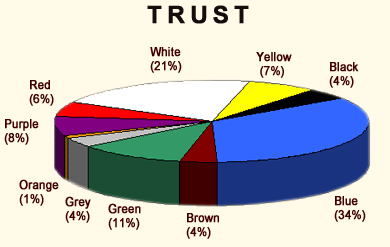
Here is also the graphical representation of how different colors are associated with trust.


Color Prompts You to Buy


As can seen from the above table, red and orange colors are most often used to encourage your action, i.e. to prompt you to buy something or subscribe to the newsletter (and become the customer later on).

Green and blue, on the other hand, are “supporting colors” that make you feel secure and safe thus entrust the seller with your money.

Color Depends on the Season

Another way to appeal to your eye is to choose colors on occasion. Many e-shops change design from season to season to make you feel more at home. You’ll see more red/orange designs in autumn, blue/white – in winter and green websites in spring.

Besides, it is a frequently-used trick to change colors depending on the approaching holidays: green and red combination is associated with Christmas (as they symbolize Christmas tree and Santa Clause); red is often used on St Valentine’s day (as that’s the color of heart and love), orange is associated with Halloween because pumpkins are a big part of that holiday (of course, all the aforementioned associations may vary from country to country).

Online Merchandising

Merchandise Selection
- Luxury Products
- Thrift Products
- Unique Products
- Popular Trend & Accessories
- Unavailable Nationwide

PayPal
- Accept online payments via PayPal
  • Fee of 2.4% to 3.4% + P15.00 PHP on received online payments
- Attach a Bank Account and a Credit Card
- Withdrawal of PayPal balance to a bank account
  • Free if PHP7,000.00 or more is withdrawn
  • PHP50.00 withdrawal fee if less than PHP7,000.00 is withdrawn
  • PHP250.00 return fee if name doesn't match bank account
  • PHP500.00 minimum withdrawal amount

eBay.ph
- Online marketplace to sell merchandise
- List merchandise individually or open an eBay store
  • Basic Store (PHP 150.00 per month) An ideal solution for lower-volume sellers who already sell on eBay but want to take the next step with an easy to use, customisable Web store.
  • Featured Store (PHP 750.00 per month) All of the benefits of a Basic Store plus more advanced customisation and business tools. A more comprehensive solution for small to medium-sized sellers who want to aggressively grow their online business.
  • Anchor Store (PHP 3,000.00 per month) All of the benefits of a Featured Store plus increased marketing support, making it an optimal solution for larger-volume sellers who are looking for maximum exposure on eBay.
- Pricing
  • Lowest Price = (1.08 x (Item Cost + Other Incidentals) + 15) / 1.034
  • Actual Price = (1.20 x (Item Cost + Other Incidentals) + 15) / 1.034
  • ROI  > 8% : Return on Investment must be greater than Fixed Deposit Interest Rate of 8%
- Payment via PayPal

- Postage
  • Package Rate Calculator LBC
  • Offer free postage list price as "Actual Price" + Luzon-Mindanao Postage
- Packaging
  • Send items in a sturdy and slightly larger box than the item you are sending.
  • Protect your item with cushioning like bubble wrap or packing peanuts.
  • Seal the package with 2" packing tape. Tape the opening of the box and reinforce all seams.
  • Attach correct labeling of consignee and include a return address.
  • Generate repeat business. Include a business card or note with your eBay user ID to thank your buyer for their business.

Use My eBay to track all your activity; it is especially useful if you have more than one item for sale or if you are both selling and bidding on several items.

My Messages is a secure place to receive eBay alerts about promotions and eBay information.

Once the listing ends, it's time to collect your payment from the buyer and send the item. Here are a few things to remember:

* After the listing ends, contact your buyer to arrange payment and delivery details
* Remember to only post the item after you've received payment from the buyer.
* Package your item well to limit the risk of damage.
* Leave feedback for your buyer and encourage them to do the same for you.

Advertise

Behavioral Merchandising

Behavioral merchandising is the art and science of using customer behavior to place, promote and display products in order to maximize retail sales revenue. In an online retail context, examples includes using data on where visitors come from, what they search for, what they click on and what they buy, to drive as relevant product promotions to each visitor at every point of interaction as possible.

Example applications include features such as "people who, like you, came here from... searching for... usually ended up buying..." and "customers who bought this item also bought...".

Behavioral merchandising was originally made famous by Amazon.com, but has evolved much further. Today, it is practiced at online retailers everywhere on the globe - companies whose turnover can be anything from $1 million to $1 billion and beyond.

The popularity of behavioral merchandising stems from the fact that it has been proven to be up to 300% more effective than customer segmentation in impacting sales per visitor through raising conversion rates and average order values.

Behavioral merchandising offers a personalized shopping experience for visitors that is highly relevant, trustworthy, and that adapts to changing customer preferences automatically. The automation aspect also means it offers retailers an opportunity to cut costs of manual merchandising, while at the same time achieving better results.

What is merchandising?
"Merchandising means maximizing merchandise sales using product selection, product design, product packaging, product pricing, and product display that stimulates consumers to spend more. This includes disciplines in pricing and discounting, physical presentation of products and displays, and the decisions about which products should be presented to which customers at what time."

An Established Practice
Merchandising is a relatively old practice used by retail stores to increase sales. Some well-known examples of traditional merchandising include placing and promoting - Candy by the check-outs - Children's yogurt at the eye level of children - Milk at the back of the store

Predictably, merchandising has migrated into electronic sales and is today a natural part of every major e-commerce site. As in the traditional sense, electronic merchandising is about maximizing the conversion rate and the average order value through displaying the right products in the right way to the right individuals.

Why Merchandising Matters
We have established that retail merchandising is the art of increasing sales, in other words maximizing sales revenue from a given audience of visitors to a retail outlet. To understand the importance of merchandising, we must also put it in relation to advertising, which is basically the art and process of driving an audience of visitors to the outlet in the first place.

A retail outlet will typically want to spend a given amount of money on advertising to drive as much relevant traffic as possible to the outlet - maximizing the performance metric cost-per-visitor or cost-per-click as it is often referred to.

The retail outlet will then want to practice the best possible merchandising in order to convert this traffic into as many buying customers as possible - maximizing the performance metric conversion rate. To generate as much value out of the traffic generated the retail outlet want to make each visitor to buy as much as possible - maximizing the performance metric average order value.

In short, the success of the retailer's efforts in maximizing cost-per-visitor, conversion rate and average order value will more or less define the sales revenue generated by the outlet. Adding the cost-of-goods-sold margin or average product margin completes the model to define the operating profit that the outlet will generate.

It becomes clear that there are basically four levers that the manager of a retail outlet can pull to try to maximize profits. Unfortunately not all the four levers are under the retailer's control.

The ultimate aim of advertising, merchandising and purchasing combined is to maximize the operating profit of the retailer. Four key performance metrics that define the success of this process - Cost Per Click, Conversion Rate, Average Order Value, and Cost of Goods Sold margin.

But only the Conversion Rate and Average Order Value metrics, which together quantify the success of the merchandising process, are directly under the retailer's control. ' In an online environment much of the traffic is purchased along a CPC-model. CPC is the cost-per click or cost-per-visitor paid to a media company for each visitor driven to the e-commerce site. The CPC-prices are relatively perfectly priced through supply and demand. The retailer must simply pay what the market demands for advertising.

The gross margin for products sold is primarily dependent on the success of the other levers, i.e. on the volume bought by the retailer - so it cannot be pulled independently. This leaves the retailer with two levers that are in his control to maximize: the "conversion rate" and the "average order value". Together they quantify the success of the retailer's merchandising process.

In other words, merchandising offers the two levers for profitability that is uniquely in the control of any given retailer to maximize the revenue in order to deliver better financial results than the competition.

Three Methods Of Merchandising
Electronic merchandising can be divided into three methods: mass-, segmented- and personalized merchandising,

Each of the methods can be found also in "offline" retail merchandising

- Mass merchandising: The approach that by necessity is used in stores, as the store assortment is the same for every visitor.

- Segmented merchandising: The approach typically used by mail order companies, in which separate catalogues are constructed to match the expected interests of a certain user demography (e.g., region, age, gender) or product category.

- Personalized merchandising: Shopping assistants or "personal shoppers" who guide the visitor through the store highlighting and recommending items based on their understanding of the user's profile and needs.

The mass and segmented approaches are typically top-down approaches; one or a small group of people (employees of the retailer) creates and manually administrates the merchandising.

Personalized merchandising is almost inherently a bottom-up approach as it is impossible or exceedingly expensive for the retailer to manually create personalization for each and every customer or product. Bottom-up meaning a web 2.0-like approach, in which all visitors contribute to the merchandising either explicitly (by submitting ratings, reviews, listings etc) or implicitly (by the data they provide through their actions taken on the site)

Explicit contributions are typically made intentionally by a smaller sub-set of all visitors - according to usability expert Jakob Nielsen, as little as 1 out of every 100 users on a typical social site. All visitors, on the other hand, inherently make implicit contributions - intentionally or not. Combined, these user generated contributions can be mined as a collective and form the basis for behavioral merchandising. ' What is behavioral merchandising?

Personalized Merchandising
Behavioral merchandising ("BEM") means using customer contributed behavioral data to automatically achieve a credible and efficient merchandising. BEM was made famous through Amazon's implementation of "those who bought this also bought", but has evolved to be much more than that. One might call BEM the combination or intersection of retail merchandising and social networks. In effect, BEM in an online retail context means turning an e-commerce site into a social network focused on creating a pleasant, socially interactive and interesting personal shopping experience for visitors.

As mentioned previously, there are two types of BEM; implicit and explicit. With implicit BEM the actions that are taken by customers - click patterns, searches done, products purchased - are analyzed and used to create the merchandising. Explicit BEM is when customers explicitly say something about a product, for example submitting a review or recommending a product to a friend.

Implicit
- Those who bought this also
- Recommendations based on the product currently being viewed.
- Based on all your previous interactions with us, our community of users thinks you're looking for...
- Recommendations to an individual customer.
- Based on the contents of your shopping cart, our community of users thinks you might want to add one of the following items...
- Recommendations based on the content of the basket.
- Based on the way you've navigated our site so far, our community of users thinks you're looking for...
- Recommendations based on clicks made on a site.
- Those who searched for... selected....
- Recommended search results.
- Those like you who came here from... searching for... usually ended up buying...
- Adaptive landing pages based on the search phrase used on an external search engine such as Google, which site a visitor arrived from, and visitor data such as browser, operating system and language.

Explicit - Ratings & reviews - Share this product with a friend, e.g., by email, link or to a social network - Customer-created product lists

Social Network Service "A social network service uses software to build online social networks for communities of people who share interests and activities or who are interested in exploring the interests and activities of others." Source: Wikipedia

The Value Of Behavioral Merchandising
The ultimate rationale for BEM lies of course in the superior contribution to financial success that it brings to retailers in comparison to the other available approaches to merchandising. Studies have shown that measured as revenue-per-visitor (i.e., the combined contribution to conversion rate and average order value) the contribution of BEM is up to 300% greater than the contribution that a segmented merchandising approach will give.

The primary explanations to the superior results delivered by BEM lies primarily in that BEM is:

- Relevant:  Because all customers combined are always more likely to collectively possess greater knowledge about all products as well as the way they are purchased and consumed than a limited team of professional merchandisers. BEM gives each individual visitor a more personally relevant shopping experience, helping each one to find precisely the products or promotions that is most relevant to them in each given situation.

Personalized merchandising using behavioral methods has proven by far the most effective In studies conducted by Avail at customers, behavioral merchandising has generated up to 300% better results than segmented merchandising by being more relevant, trustworthy and adaptive.

- Trustworthy: BEM is ultimately generated by peer consumers, as opposed to by marketing professionals which is the case in all other approaches, and thus creates trust. Research clearly shows that consumers are much more likely to trust peers than professional marketers, in particular online.

- Adaptive: Because BEM can be made to take into account the collective behavior of all visitors in real-time, it can respond to quickly changing - and sometimes fickle - preferences of visitors and consumers and it can apply that response in real-time from one interaction to another by the same visitor during a visit to the outlet.

Apart from the superior contribution to revenue-per-visitor, BEM has several other advantages over other approaches, including the fact that it can be made highly or completely automated, requiring no on-going human administration or maintenance and so reducing the cost of merchandising operations, even for very large product ranges and very large groups of visitors.

Burt Goldman - The Five Rules of Happiness

You know when you're happy, and certainly no one has to tell you when you're sad. But what is it that makes a person happy?

It is important to realize that what makes you happy might depress another person. There are people, because of guilt, a feeling they do not deserve what they have, or a feeling they will lose what they have that makes them unhappy when they should be happy.

Possessions are a poor measure of happiness. Possessions are subjective and relative to the individual and the individual's viewpoint. Instead, we will use a philosophy as an example.

This philosophy is about enjoying things you like, avoiding or changing things you do not like, and accepting what you cannot avoid or change by the skillful use of your viewpoint. The use of this philosophy, as embodied in the five rules, will allow you to test many problem areas in your life and find solutions. With this philosophy, you will be well on your way on your pursuit of happiness.

Rule Number One: If You Like a Thing, Enjoy It.

Now that seems outrageously simple. At first you might say, "That's ridiculous, of course if I like something I'm going to enjoy it." But when you stop to think about it you'll probably agree that there are many things in life that we like but don't enjoy. The reasons we don't enjoy things we like are (a) guilt, and (b) fear. You will not enjoy something you like if you feel guilty after having done the thing, or if you are fearful of the consequences of doing it.

Rule Number Two: If You Don't Like a Thing, Avoid It.

The second rule seems simple enough, but reflect for a moment on how many people are involved with things they do not like — a job, a person, a vehicle, a type of food, any one of a thousand things — and for some reason they don't avoid those things. "Well, I can't avoid it. I have to work there because I need the money." Or, "I have to be involved with this person for many valid reasons." How many justifications can you think of for not avoiding the things you do not like to do?

Rule Number Three: If You Don't Like a Thing, and You Cannot Avoid It, Change It.

Here again, the answer is simple: change it. But just as in avoidance we rationalize that we need something about it — the money, the time, the security — something is holding you to that particular thing if you don't like it, cannot avoid it, won't change it, but are still involved with it.

Rule Number Four: If You Don't Like a Thing, Cannot Avoid It, and Cannot or will Not Change It, Accept It.

Acceptance — now there is a catch. How can you accept something you don't like? How in the world do you accept something that is 'unacceptable'? How do you accept a situation that you're not happy with? How do you accept a person that you're not happy with? Well, you really don't have to accept anything; you can, of course, be unhappy. If you don't like it, won't change it, cannot avoid it, and will not accept it, I guarantee that you will be unhappy. There are, however, five rules to the secret of happiness, and within the fifth lies the key.

Rule Number Five: You Accept a Thing By Changing Your Attitude Towards It.

You are the result of your viewpoints and attitudes. Everything is relative to the person experiencing it. There are no absolutes — nothing is good, nothing bad, except as it relates to you. Nor is life good or bad. Life simply is. You change those things you wish by changing your viewpoint about them.

How easy!
How difficult!

Your attitudes and viewpoints are all part of your mind and once you develop the power of self mind control you will be the master of your own attitudes and viewpoints. Using these five rules you'll soon find yourself on the right path on the pursuit of happiness. You'll realize why people are unhappy. Eventually it will become automatic, and you'll find happiness a predominant state of mind. Once you realize the ease of acquiring this emotion, you develop an entirely new scale of highs and lows.

Unremitting happiness, of course, is not a possible or desirable state. According to the principle of rhythm, there is always an inflow and outflow, an ebb tide and a flood tide. You'll always have highs and lows — there's no way to avoid that. However, your highs will be higher and your lows will be higher. You'll then find that what is a happy state for you might be a state of depression for someone unaware of the Five Rules of Happiness.

Author Unknown - The Awakening

A time comes in your life when you finally get it…when, in the midst of all your fears and insanity, you stop dead in your tracks and somewhere the voice inside your head cries out…ENOUGH! Enough fighting and crying and blaming and struggling to hold on.

Then, like a child quieting down after a tantrum, you blink back your tears and begin to look at the world through new eyes.

This is your awakening.

You realize it’s time to stop hoping and waiting for something to change, or for happiness, safety and security to magically appear over the next horizon. You realize that in the real world there aren’t always fairy tale endings, and that any guarantee of “happily ever after” must begin with you… and in the process a sense of serenity is born of acceptance.

You awaken to the fact that you are not perfect and that not everyone will always love, appreciate or approve of who or what you are… and that’s OK. They are entitled to their own views and opinions.

You learn the importance of loving and championing yourself… and in the process a sense of new found confidence is born of self-approval. You stop complaining and blaming other people for the things they did to you – or didn’t do for you – and you learn that the only thing you can really count on is the unexpected.

You learn that people don’t always say what they mean or mean what they say and that not everyone will always be there for you and that everything isn’t always about you.

So, you learn to stand on your own and to take care of yourself… and in the process a sense of safety and security is born of self-reliance.

You stop judging and pointing fingers and you begin to accept people as they are and to overlook their shortcomings and human frailties… and in the process a sense of peace and contentment is born of forgiveness.

You learn to open up to new worlds and different points of view. You begin reassessing and redefining who you are and what you really stand for.

You learn the difference between wanting and needing and you begin to discard the doctrines and values you’ve outgrown, or should never have bought into to begin with.

You learn that there is power and glory in creating and contributing and you stop maneuvering through life merely as a “consumer” looking for your next fix.

You learn that principles such as honesty and integrity are not the outdated ideals of a bygone era, but the mortar that holds together the foundation upon which you must build a life.

You learn that you don’t know everything, it’s not your job to save the world and that you can’t teach a pig to sing. You learn that the only cross to bear is the one you choose to carry and that martyrs get burned at the stake.

Then you learn about love. You learn to look at relationships as they really are and not as you would have them be. You learn that alone does not mean lonely.

You stop trying to control people, situations and outcomes. You learn to distinguish between guilt and responsibility and the importance of setting boundaries and learning to say NO.

You also stop working so hard at putting your feelings aside, smoothing things over and ignoring your needs.

You learn that your body really is your temple. You begin to care for it and treat it with respect. You begin to eat a balanced diet, drink more water, and take more time to exercise.

You learn that being tired fuels doubt, fear, and uncertainty and so you take more time to rest. And, just as food fuels the body, laughter fuels our soul. So you take more time to laugh and to play.

You learn that, for the most part, you get in life what you believe you deserve, and that much of life truly is a self-fulfilling prophecy.

You learn that anything worth achieving is worth working for and that wishing for something to happen is different than working toward making it happen.

More importantly, you learn that in order to achieve success you need direction, discipline and perseverance.

You also learn that no one can do it all alone, and that it’s OK to risk asking for help.

You learn the only thing you must truly fear is fear itself. You learn to step right into and through your fears because you know that whatever happens you can handle it and to give in to fear is to give away the right to live life on your own terms.

You learn to fight for your life and not to squander it living under a cloud of impending doom.

You learn that life isn’t always fair, you don’t always get what you think you deserve and that sometimes bad things happen to unsuspecting, good people… and you learn not to always take it personally.

You learn that nobody’s punishing you and everything isn’t always somebody’s fault. It’s just life happening.

You learn to admit when you are wrong and to build bridges instead of walls.

You learn that negative feelings such as anger, envy and resentment must be understood and redirected or they will suffocate the life out of you and poison the universe that surrounds you.

You learn to be thankful and to take comfort in many of the simple things we take for granted, things that millions of people upon the earth can only dream about: a full refrigerator, clean running water, a soft warm bed, a long hot shower.

Then, you begin to take responsibility for yourself by yourself and you make yourself a promise to never betray yourself and to never, ever settle for less than your heart’s desire.

You make it a point to keep smiling, to keep trusting, and to stay open to every wonderful possibility.

You hang a wind chime outside your window so you can listen to the wind.

Finally, with courage in your heart, you take a stand, you take a deep breath, and you begin to design the life you want to live as best you can.