French Bowline Knot
The French Bowline is a knot that neither slips nor jams and unties easily. It has two loops that can be adjusted to fit.
Square Knot
The square knot, also called the reef knot, is the best known knot for bending two lines together. However, it can jam on a strain and become very difficult to untie.
Clove Hitch
A clove hitch is the best all-round knot for bending to a ring, spar, or anything else that is round or nearly round.
Half Hitch
A clove hitch will not jam and seldom pulls out. A slack clove hitch, however, might work itself out. For that reason, it is a good idea to put a half hitch in the end. A half hitch, by the way, never becomes a whole hitch. Put another one on, and all you have is two half hitches.
The Climb
Which Goat are You?
Green Goats
- A goat who wants to help others.
- A goat who focuses on having friends.
- A goat who takes responsibilities for own mistakes.
- A goat who assumes nothing and takes courage to ask questions.
- A goat who respects others intelligence.
- A goat who listens.
- A goat obsessed with facts and truths.
- A goat who knows limits and accepts it can be wrong.
- A goat who is not afraid to fail because failure is an option.
- A goat who is not afraid of success.
- A goat who discuss problems with others.
- A goat who takes nothing personally.
- A goat impeccable with own words.
- A goat who understands.
- A goat who knows not everything and try to know more.
- A goat who is grateful for the present.
Red Goats
- A goat who scorns the efforts of others.
- A goat who focuses on differences with others.
- A goat who blames the world for all problems.
- A goat who assumes the worst of everyone.
- A goat who won't take responsibility.
- A goat who is afraid.
- A goat who has to be right in everything.
- A goat who tells others.
- A goat who see no flaws and thinks its always right.
- A goat who takes out problems on others.
- A goat who takes everything personally.
- A goat who knows everything.
- A goat obsessed with status.
- A goat who believes its about age.
- A goat who thinks it is entitled and the world owes it everything.
Coping with Infidelity and Breakup
Lost and all alone
I always thought that I could make it on my own
Since you left I hardly make it through the day
My tears get in the way
And I need you back to stay
I wander through the night
And search the world to find
The words to make it right
All I want is just the way it used to be
With you here close to me
I’ve got to make you see
That I’m lost without your love
Life without you isn’t worth the trouble of
I’m as helpless as a ship without a wheel
A touch without a feel
I can’t believe it’s real...
And someday soon I’ll wake
And find my heart won’t have to break
Yes I’m lost without your love
Life without you isn’t worth the trouble of
All I want is just the way it used to be
I need you here with me
Oh darlin’ can’t you see...
If we had love before
We can have it back once more
Recover from a Breakup
Why do breakups hurt so much, even when the relationship is no longer good? A divorce or breakup is painful because it represents the loss, not just of the relationship, but also of shared dreams and commitments. Romantic relationships begin on a high note of excitement and hope for the future. When these relationships fail, we experience profound disappointment, stress, and grief.
Coping with a spouse's infidelity is one of life's most stressful events. Discovering that a spouse has cheated, or even entertaining suspicions that a partner might be cheating, can be a devastating experience. A spouse's infidelity often brings forth feelings of rejection, betrayal, anger, sadness, and doubt.
Recovering from a breakup or divorce is difficult. However, it’s important to know (and to keep reminding yourself) that you can and will move on. But healing takes time, so be patient with yourself.
Allow Yourself to Grieve
Grief is a natural reaction to loss, and the breakup or divorce of a love relationship involves multiple losses:
- Loss of companionship and shared experiences (which may or may not have been consistently pleasurable)
- Loss of support, be it financial, intellectual, social, or emotional
- Loss of hopes, plans, and dreams (can be even more painful than practical losses)
Care For Yourself
- Make time each day to nurture yourself. Help yourself heal by scheduling daily time for activities you find calming and soothing. Go for a walk in nature, listen to music, enjoy a hot bath, get a massage, read a favorite book, take a yoga class, or savor a warm cup of tea.
- Pay attention to what you need in any given moment and speak up to express your needs. Honor what you believe to be right and best for you even though it may be different from what your ex or others want. Say "no" without guilt or angst as a way of honoring what is right for you.
- Stick to a routine. A divorce or relationship breakup can disrupt almost every area of your life, amplifying feelings of stress, uncertainty, and chaos. Getting back to a regular routine can provide a comforting sense of structure and normalcy.
- Take a time out. Try not to make any major decisions in the first few months after a separation or divorce, like starting a new job or moving to a new city. If you can, wait until you’re feeling less emotional so that you can make better decisions.
- Avoid using alcohol, drugs, or food to cope. When you’re in the middle of a breakup, you may be tempted to do anything to relieve your feelings of pain and loneliness. But using alcohol, drugs, or food as an escape is unhealthy and destructive in the long run. It’s essential to find healthier ways of coping with painful feelings.
- Explore new interests. A divorce or breakup is a beginning as well as an end. Take the opportunity to explore new interests and activities. Pursuing fun, new activities gives you a chance to enjoy life in the here-and-now, rather than dwelling on the past.
This is Your Awakening
You realize it’s time to stop hoping and waiting for something to change, or for happiness, safety and security to magically appear over the next horizon. You realize that in the real world there aren’t always fairy tale endings, and that any guarantee of “happily ever after” must begin with you… and in the process a sense of serenity is born of acceptance.
You learn that people don’t always say what they mean or mean what they say and that not everyone will always be there for you and that everything isn’t always about you.
So, you learn to stand on your own and to take care of yourself… and in the process a sense of safety and security is born of self-reliance.
Then you learn about love. You learn to look at relationships as they really are and not as you would have them be. You learn that alone does not mean lonely.
Then, you begin to take responsibility for yourself by yourself and you make yourself a promise to never betray yourself and to never, ever settle for less than your heart’s desire.
You make it a point to keep smiling, to keep trusting, and to stay open to every wonderful possibility.
You hang a wind chime outside your window so you can listen to the wind.
Finally, with courage in your heart, you take a stand, you take a deep breath, and you begin to design the life you want to live as best you can.
Colors
Color is believed to be one of the most powerful elements of design for web sites, direct mail, ads, and other marketing materials. It carries meaning through associations and/or your body physical response. Color associates can vary from country to country but in Western culture they are basically the same.
So don’t let (online) sellers affect your decision by showing you what you want to see. Let’s see how color choice may affect your shopping behavior and habits – for you to be able to buy with a cool head.
Facts we should also know about colors:
* Color is a powerful promotional tool;
* Colors should be trendy and catchy (use “colors that pop”);
* Between 60% and 90% of website initial assessment is based on its color.
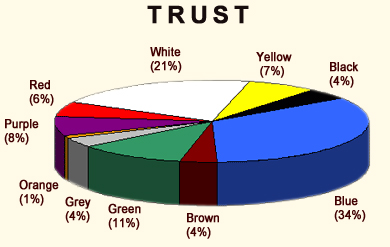
Here is also the graphical representation of how different colors are associated with trust.
As can seen from the above table, red and orange colors are most often used to encourage your action, i.e. to prompt you to buy something or subscribe to the newsletter (and become the customer later on).
Green and blue, on the other hand, are “supporting colors” that make you feel secure and safe thus entrust the seller with your money.
Color Depends on the Season
Another way to appeal to your eye is to choose colors on occasion. Many e-shops change design from season to season to make you feel more at home. You’ll see more red/orange designs in autumn, blue/white – in winter and green websites in spring.
Besides, it is a frequently-used trick to change colors depending on the approaching holidays: green and red combination is associated with Christmas (as they symbolize Christmas tree and Santa Clause); red is often used on St Valentine’s day (as that’s the color of heart and love), orange is associated with Halloween because pumpkins are a big part of that holiday (of course, all the aforementioned associations may vary from country to country).
So don’t let (online) sellers affect your decision by showing you what you want to see. Let’s see how color choice may affect your shopping behavior and habits – for you to be able to buy with a cool head.
Effects of Colors in Business
Facts we should also know about colors:
* Color is a powerful promotional tool;
* Colors should be trendy and catchy (use “colors that pop”);
* Between 60% and 90% of website initial assessment is based on its color.
Here is also the graphical representation of how different colors are associated with trust.
As can seen from the above table, red and orange colors are most often used to encourage your action, i.e. to prompt you to buy something or subscribe to the newsletter (and become the customer later on).
Green and blue, on the other hand, are “supporting colors” that make you feel secure and safe thus entrust the seller with your money.
Color Depends on the Season
Another way to appeal to your eye is to choose colors on occasion. Many e-shops change design from season to season to make you feel more at home. You’ll see more red/orange designs in autumn, blue/white – in winter and green websites in spring.
Besides, it is a frequently-used trick to change colors depending on the approaching holidays: green and red combination is associated with Christmas (as they symbolize Christmas tree and Santa Clause); red is often used on St Valentine’s day (as that’s the color of heart and love), orange is associated with Halloween because pumpkins are a big part of that holiday (of course, all the aforementioned associations may vary from country to country).
Online Merchandising
Merchandise Selection
- Luxury Products
- Thrift Products
- Unique Products
- Popular Trend & Accessories
- Unavailable Nationwide
PayPal
- Accept online payments via PayPal
- Withdrawal of PayPal balance to a bank account
eBay.ph
- Online marketplace to sell merchandise
- List merchandise individually or open an eBay store
- Postage
Use My eBay to track all your activity; it is especially useful if you have more than one item for sale or if you are both selling and bidding on several items.
My Messages is a secure place to receive eBay alerts about promotions and eBay information.
Once the listing ends, it's time to collect your payment from the buyer and send the item. Here are a few things to remember:
* After the listing ends, contact your buyer to arrange payment and delivery details
* Remember to only post the item after you've received payment from the buyer.
* Package your item well to limit the risk of damage.
* Leave feedback for your buyer and encourage them to do the same for you.
Advertise
- Luxury Products
- Thrift Products
- Unique Products
- Popular Trend & Accessories
- Unavailable Nationwide
PayPal
- Accept online payments via PayPal
- Fee of 2.4% to 3.4% + P15.00 PHP on received online payments
- Withdrawal of PayPal balance to a bank account
- Free if PHP7,000.00 or more is withdrawn
- PHP50.00 withdrawal fee if less than PHP7,000.00 is withdrawn
- PHP250.00 return fee if name doesn't match bank account
- PHP500.00 minimum withdrawal amount
eBay.ph
- Online marketplace to sell merchandise
- List merchandise individually or open an eBay store
- Basic Store (PHP 150.00 per month) An ideal solution for lower-volume sellers who already sell on eBay but want to take the next step with an easy to use, customisable Web store.
- Featured Store (PHP 750.00 per month) All of the benefits of a Basic Store plus more advanced customisation and business tools. A more comprehensive solution for small to medium-sized sellers who want to aggressively grow their online business.
- Anchor Store (PHP 3,000.00 per month) All of the benefits of a Featured Store plus increased marketing support, making it an optimal solution for larger-volume sellers who are looking for maximum exposure on eBay.
- Lowest Price = (1.08 x (Item Cost + Other Incidentals) + 15) / 1.034
- Actual Price = (1.20 x (Item Cost + Other Incidentals) + 15) / 1.034
- ROI > 8% : Return on Investment must be greater than Fixed Deposit Interest Rate of 8%
- Postage
- Package Rate Calculator LBC
- Offer free postage list price as "Actual Price" + Luzon-Mindanao Postage
- Send items in a sturdy and slightly larger box than the item you are sending.
- Protect your item with cushioning like bubble wrap or packing peanuts.
- Seal the package with 2" packing tape. Tape the opening of the box and reinforce all seams.
- Attach correct labeling of consignee and include a return address.
- Generate repeat business. Include a business card or note with your eBay user ID to thank your buyer for their business.
Use My eBay to track all your activity; it is especially useful if you have more than one item for sale or if you are both selling and bidding on several items.
My Messages is a secure place to receive eBay alerts about promotions and eBay information.
Once the listing ends, it's time to collect your payment from the buyer and send the item. Here are a few things to remember:
* After the listing ends, contact your buyer to arrange payment and delivery details
* Remember to only post the item after you've received payment from the buyer.
* Package your item well to limit the risk of damage.
* Leave feedback for your buyer and encourage them to do the same for you.
Advertise
Behavioral Merchandising
Behavioral merchandising is the art and science of using customer behavior to place, promote and display products in order to maximize retail sales revenue. In an online retail context, examples includes using data on where visitors come from, what they search for, what they click on and what they buy, to drive as relevant product promotions to each visitor at every point of interaction as possible.
Example applications include features such as "people who, like you, came here from... searching for... usually ended up buying..." and "customers who bought this item also bought...".
Behavioral merchandising was originally made famous by Amazon.com, but has evolved much further. Today, it is practiced at online retailers everywhere on the globe - companies whose turnover can be anything from $1 million to $1 billion and beyond.
The popularity of behavioral merchandising stems from the fact that it has been proven to be up to 300% more effective than customer segmentation in impacting sales per visitor through raising conversion rates and average order values.
Behavioral merchandising offers a personalized shopping experience for visitors that is highly relevant, trustworthy, and that adapts to changing customer preferences automatically. The automation aspect also means it offers retailers an opportunity to cut costs of manual merchandising, while at the same time achieving better results.
What is merchandising?
"Merchandising means maximizing merchandise sales using product selection, product design, product packaging, product pricing, and product display that stimulates consumers to spend more. This includes disciplines in pricing and discounting, physical presentation of products and displays, and the decisions about which products should be presented to which customers at what time."
An Established Practice
Merchandising is a relatively old practice used by retail stores to increase sales. Some well-known examples of traditional merchandising include placing and promoting - Candy by the check-outs - Children's yogurt at the eye level of children - Milk at the back of the store
Predictably, merchandising has migrated into electronic sales and is today a natural part of every major e-commerce site. As in the traditional sense, electronic merchandising is about maximizing the conversion rate and the average order value through displaying the right products in the right way to the right individuals.
Why Merchandising Matters
We have established that retail merchandising is the art of increasing sales, in other words maximizing sales revenue from a given audience of visitors to a retail outlet. To understand the importance of merchandising, we must also put it in relation to advertising, which is basically the art and process of driving an audience of visitors to the outlet in the first place.
A retail outlet will typically want to spend a given amount of money on advertising to drive as much relevant traffic as possible to the outlet - maximizing the performance metric cost-per-visitor or cost-per-click as it is often referred to.
The retail outlet will then want to practice the best possible merchandising in order to convert this traffic into as many buying customers as possible - maximizing the performance metric conversion rate. To generate as much value out of the traffic generated the retail outlet want to make each visitor to buy as much as possible - maximizing the performance metric average order value.
In short, the success of the retailer's efforts in maximizing cost-per-visitor, conversion rate and average order value will more or less define the sales revenue generated by the outlet. Adding the cost-of-goods-sold margin or average product margin completes the model to define the operating profit that the outlet will generate.
It becomes clear that there are basically four levers that the manager of a retail outlet can pull to try to maximize profits. Unfortunately not all the four levers are under the retailer's control.
The ultimate aim of advertising, merchandising and purchasing combined is to maximize the operating profit of the retailer. Four key performance metrics that define the success of this process - Cost Per Click, Conversion Rate, Average Order Value, and Cost of Goods Sold margin.
But only the Conversion Rate and Average Order Value metrics, which together quantify the success of the merchandising process, are directly under the retailer's control. ' In an online environment much of the traffic is purchased along a CPC-model. CPC is the cost-per click or cost-per-visitor paid to a media company for each visitor driven to the e-commerce site. The CPC-prices are relatively perfectly priced through supply and demand. The retailer must simply pay what the market demands for advertising.
The gross margin for products sold is primarily dependent on the success of the other levers, i.e. on the volume bought by the retailer - so it cannot be pulled independently. This leaves the retailer with two levers that are in his control to maximize: the "conversion rate" and the "average order value". Together they quantify the success of the retailer's merchandising process.
In other words, merchandising offers the two levers for profitability that is uniquely in the control of any given retailer to maximize the revenue in order to deliver better financial results than the competition.
Three Methods Of Merchandising
Electronic merchandising can be divided into three methods: mass-, segmented- and personalized merchandising,
Each of the methods can be found also in "offline" retail merchandising
- Mass merchandising: The approach that by necessity is used in stores, as the store assortment is the same for every visitor.
- Segmented merchandising: The approach typically used by mail order companies, in which separate catalogues are constructed to match the expected interests of a certain user demography (e.g., region, age, gender) or product category.
- Personalized merchandising: Shopping assistants or "personal shoppers" who guide the visitor through the store highlighting and recommending items based on their understanding of the user's profile and needs.
The mass and segmented approaches are typically top-down approaches; one or a small group of people (employees of the retailer) creates and manually administrates the merchandising.
Personalized merchandising is almost inherently a bottom-up approach as it is impossible or exceedingly expensive for the retailer to manually create personalization for each and every customer or product. Bottom-up meaning a web 2.0-like approach, in which all visitors contribute to the merchandising either explicitly (by submitting ratings, reviews, listings etc) or implicitly (by the data they provide through their actions taken on the site)
Explicit contributions are typically made intentionally by a smaller sub-set of all visitors - according to usability expert Jakob Nielsen, as little as 1 out of every 100 users on a typical social site. All visitors, on the other hand, inherently make implicit contributions - intentionally or not. Combined, these user generated contributions can be mined as a collective and form the basis for behavioral merchandising. ' What is behavioral merchandising?
Personalized Merchandising
Behavioral merchandising ("BEM") means using customer contributed behavioral data to automatically achieve a credible and efficient merchandising. BEM was made famous through Amazon's implementation of "those who bought this also bought", but has evolved to be much more than that. One might call BEM the combination or intersection of retail merchandising and social networks. In effect, BEM in an online retail context means turning an e-commerce site into a social network focused on creating a pleasant, socially interactive and interesting personal shopping experience for visitors.
As mentioned previously, there are two types of BEM; implicit and explicit. With implicit BEM the actions that are taken by customers - click patterns, searches done, products purchased - are analyzed and used to create the merchandising. Explicit BEM is when customers explicitly say something about a product, for example submitting a review or recommending a product to a friend.
Implicit
- Those who bought this also
- Recommendations based on the product currently being viewed.
- Based on all your previous interactions with us, our community of users thinks you're looking for...
- Recommendations to an individual customer.
- Based on the contents of your shopping cart, our community of users thinks you might want to add one of the following items...
- Recommendations based on the content of the basket.
- Based on the way you've navigated our site so far, our community of users thinks you're looking for...
- Recommendations based on clicks made on a site.
- Those who searched for... selected....
- Recommended search results.
- Those like you who came here from... searching for... usually ended up buying...
- Adaptive landing pages based on the search phrase used on an external search engine such as Google, which site a visitor arrived from, and visitor data such as browser, operating system and language.
Explicit - Ratings & reviews - Share this product with a friend, e.g., by email, link or to a social network - Customer-created product lists
Social Network Service "A social network service uses software to build online social networks for communities of people who share interests and activities or who are interested in exploring the interests and activities of others." Source: Wikipedia
The Value Of Behavioral Merchandising
The ultimate rationale for BEM lies of course in the superior contribution to financial success that it brings to retailers in comparison to the other available approaches to merchandising. Studies have shown that measured as revenue-per-visitor (i.e., the combined contribution to conversion rate and average order value) the contribution of BEM is up to 300% greater than the contribution that a segmented merchandising approach will give.
The primary explanations to the superior results delivered by BEM lies primarily in that BEM is:
- Relevant: Because all customers combined are always more likely to collectively possess greater knowledge about all products as well as the way they are purchased and consumed than a limited team of professional merchandisers. BEM gives each individual visitor a more personally relevant shopping experience, helping each one to find precisely the products or promotions that is most relevant to them in each given situation.
Personalized merchandising using behavioral methods has proven by far the most effective In studies conducted by Avail at customers, behavioral merchandising has generated up to 300% better results than segmented merchandising by being more relevant, trustworthy and adaptive.
- Trustworthy: BEM is ultimately generated by peer consumers, as opposed to by marketing professionals which is the case in all other approaches, and thus creates trust. Research clearly shows that consumers are much more likely to trust peers than professional marketers, in particular online.
- Adaptive: Because BEM can be made to take into account the collective behavior of all visitors in real-time, it can respond to quickly changing - and sometimes fickle - preferences of visitors and consumers and it can apply that response in real-time from one interaction to another by the same visitor during a visit to the outlet.
Apart from the superior contribution to revenue-per-visitor, BEM has several other advantages over other approaches, including the fact that it can be made highly or completely automated, requiring no on-going human administration or maintenance and so reducing the cost of merchandising operations, even for very large product ranges and very large groups of visitors.
Subscribe to:
Posts (Atom)